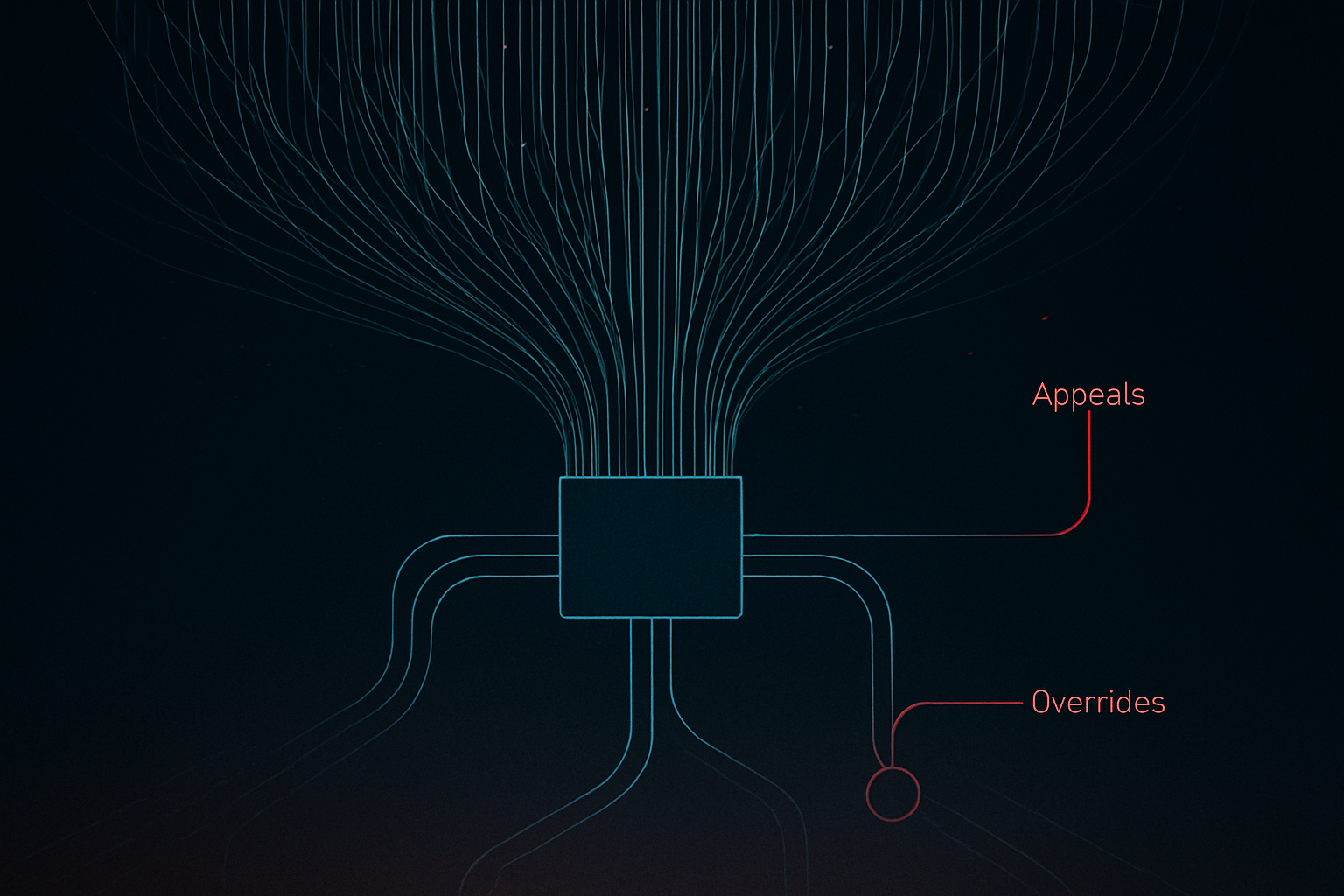
YouTube's Content ID system processed 2.5 billion copyright claims in 2025, representing a 14% year-on-year increase. The sheer volume underscores a critical reality: automated copyright enforcement at scale has become the default mechanism for managing digital content liability, and the technical and legal infrastructure underpinning it deserves closer examination.
The Scale Problem in Automated Enforcement
2.5 billion claims processed annually means YouTube's systems are making (or at least triggering) millions of copyright decisions per day. That volume necessitates almost entirely automated decision-making. Human review of even a small fraction would be economically infeasible. Content ID operates by fingerprinting uploaded material against a database of registered works, flagging matches, and applying pre-configured policies — monetise the claim, block the video, or mute audio.
The appeal of this model to platforms is clear: it provides a legal safe harbour under the DMCA's section 512(c) by demonstrating a scalable, responsive system for addressing copyright holders' concerns. The appeal to copyright holders is equally obvious — automated, at-scale enforcement without the cost and delay of manual takedown notices.
What the data doesn't immediately reveal is the false positive rate inherent in fingerprinting systems. Fingerprinting is not semantic matching; it operates on acoustic or visual similarity. Fair use, licensed samples, public domain works, or independent creation can all trigger identical or near-identical fingerprints. The system's reliance on bulk automation rather than contextual analysis is both its strength (speed, cost) and its weakness (inflexibility, overreach).
Disputes and the Asymmetry of Appeals
Despite the scale of claims, YouTube reports that disputes remain rare, yet uploaders who do challenge claims win more often than not. This asymmetry matters. It suggests that many creators either lack awareness of their appeal rights or lack confidence in their ability to prevail — even when the underlying claim may be erroneous.
From an infrastructure perspective, this pattern has implications for how hosting platforms design their own takedown and dispute workflows. A system that makes appeals difficult, opaque, or penalty-laden will suppress legitimate challenges. Conversely, one with transparent, accessible dispute mechanisms (even if more labour-intensive) encourages rightful claims to be tested. The win rate for challengers hints that Content ID's default decisions, while often correct, carry a non-trivial false positive burden.
The Paradox of Shrinking Rightsholders
Notably, the number of content ID-eligible rightsholders actually declined, even as claim volume rose. This suggests that the system is becoming more consolidated — fewer, larger rights-management entities are responsible for an ever-growing share of claims. That centralisation has both technical and strategic consequences.
Technically, it may indicate improved fingerprint database coverage by major studios and aggregators. Strategically, it reflects ongoing consolidation in music publishing, film distribution, and literary rights management. Smaller creators and independent rights holders have fewer incentives or resources to integrate with Content ID, leaving the system increasingly shaped by a handful of major players.
For hosting providers, particularly those offering DMCA-respecting or DMCA-ignored services, this centralisation matters. It means takedown pressure, where it arrives, tends to come from well-funded, sophisticated actors rather than ad-hoc copyright owners. That context shapes both the frequency and the nature of legal threats.
Infrastructure Lessons for Alternative Hosts
The billion-scale operation YouTube has built reveals one approach to content liability: automate aggressively, rely on appeals mechanisms to catch errors, and accept that some false positives are the cost of speed and scale. Alternative hosting providers, particularly those operating in jurisdictions with different DMCA rules or policies, often make different bets — more manual review, more deference to uploaders, or explicit policies that decline to process certain categories of claims.
The data YouTube has published suggests that neither approach eliminates disputes; it only shifts their burden and visibility. A smaller platform with manual review processes may avoid the scale of automated false positives but will incur higher operational costs. A fully automated system scales economically but generates noise that some uploaders will contest.
The takeaway for infrastructure operators is practical: if you're building content-hosting systems, the automation versus review trade-off is fundamental. Understanding your legal jurisdiction, your users' expectations, and your operational capacity should drive that choice — not assumption that one model is universally 'better'.
YouTube's 2.5 billion claims are a useful metric of scale, but they're also a reminder that automated enforcement, however necessary and defensible, is not a complete solution to the underlying tension between copyright protection and content creator interests. The question for alternative platforms remains: what trade-offs are you willing to make, and for whom.