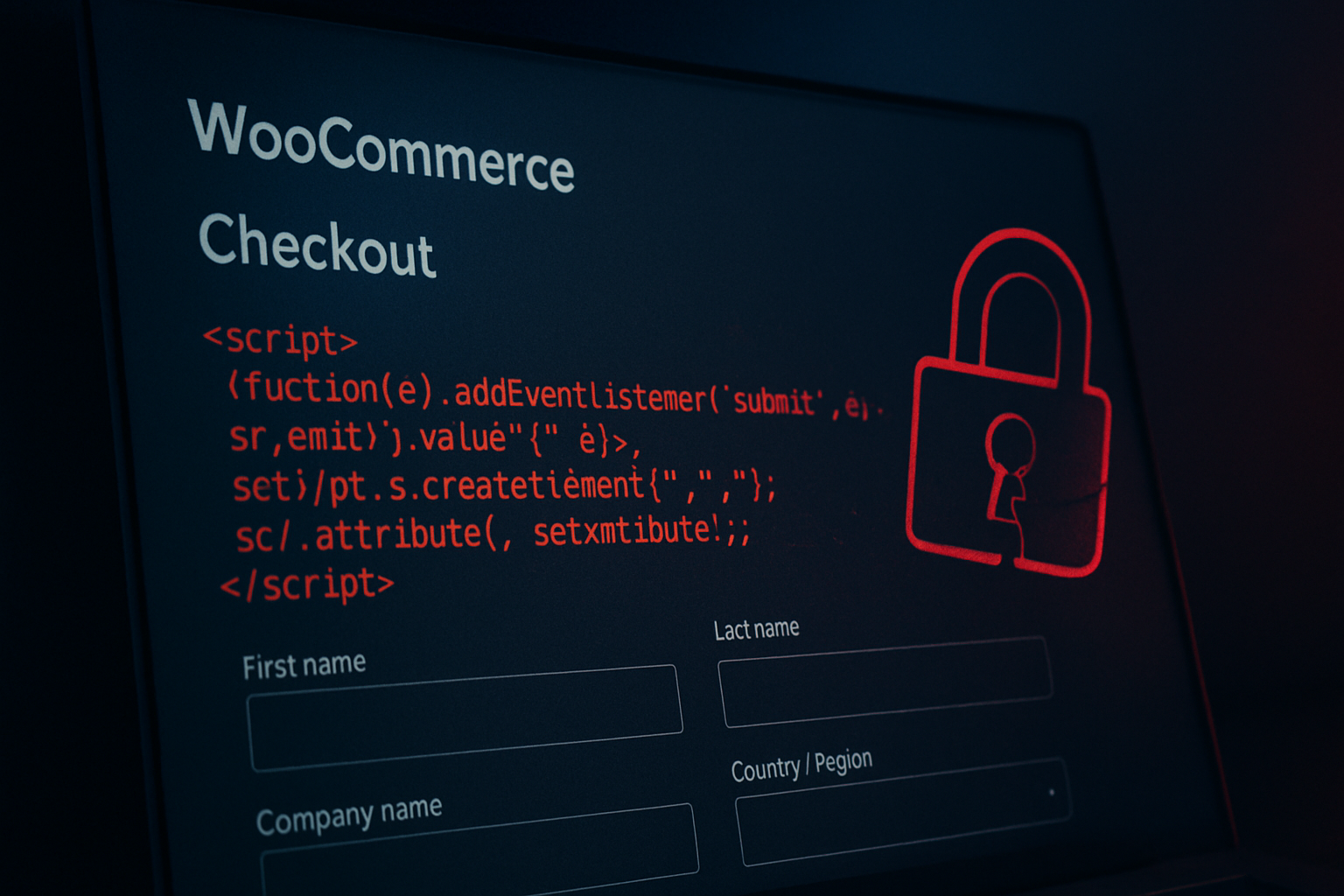
Payment card theft via compromised checkout pages remains one of the most damaging attack vectors for e-commerce operations. A recent surge in active exploitation targeting the Funnel Builder plugin for WordPress demonstrates how easily a single unpatched vulnerability can expose thousands of stores to skimming attacks.
The Attack Mechanism
The vulnerability operates through a straightforward but effective chain: attackers exploit the Funnel Builder plugin to inject malicious JavaScript directly into WooCommerce checkout pages. Once injected, this code runs in the customer's browser during the payment process, capturing card details, CVV numbers, and billing information before legitimate payment gateways ever receive the data.
This approach avoids most server-side detection because the malicious code executes client-side. Standard payment gateway logging and PCI compliance measures, which focus on what reaches the processor, often miss the exfiltration happening in the browser itself. The attacker effectively sits between the customer and the checkout form.
Why Plugin Flaws Remain High-Risk
WordPress plugin vulnerabilities carry particular danger in e-commerce contexts because a single compromised plugin can affect multiple stores if they share hosting infrastructure or use the same version without immediate patching. The Funnel Builder plugin, commonly used to optimise conversion funnels and checkout flows, has deep access to WooCommerce processes — making it an attractive target.
The gap between vulnerability disclosure and active exploitation has narrowed significantly. When no CVE identifier exists yet, public awareness lags, and many site owners remain unaware of the risk. This window of ignorance is precisely when attackers strike hardest.
Detection and Response
Site operators should monitor several indicators. Unexpected script tags appearing in checkout page source code, unusual external domains being loaded during payment flows, and spikes in failed payment attempts followed by successful charges (suggesting card data theft) are all red flags. Log analysis of plugin activity, particularly file modifications and function calls, can reveal compromise.
Immediate steps include disabling or removing the affected plugin version, scanning for injected code in the database and theme files, reviewing payment processor logs for suspicious patterns, and rotating any administrative credentials. If the store processes customer cards directly (rather than tokenising via a gateway), a PCI incident notification may be required.
Long-term defence requires maintaining a patch management process: subscribe to security advisories for all active plugins, test updates in a staging environment before production deployment, and use a Web Application Firewall capable of detecting and blocking known malicious JavaScript patterns at the edge.
Hosting-Level Protections
Infrastructure operators can contribute substantially here. File integrity monitoring on plugin directories alerts to unauthorised modifications. Request filtering can block outbound exfiltration to known malicious domains. Server-side JavaScript analysis, though computationally expensive, can flag suspicious patterns before pages reach browsers. For stores processing sensitive payment data, hosting platforms offering PCI-compliant isolated environments reduce blast radius when a single site is compromised.
The details documented by Sansec underscore why e-commerce hosting demands active security posture beyond basic patching. Skimming attacks succeed not through sophisticated zero-days but through predictable failures: outdated plugins, unmonitored file changes, and delayed incident response.
For any operation running WooCommerce at scale, the question is not whether plugin vulnerabilities will be exploited, but whether your detection and response capability can contain the damage before customer data reaches criminal infrastructure.