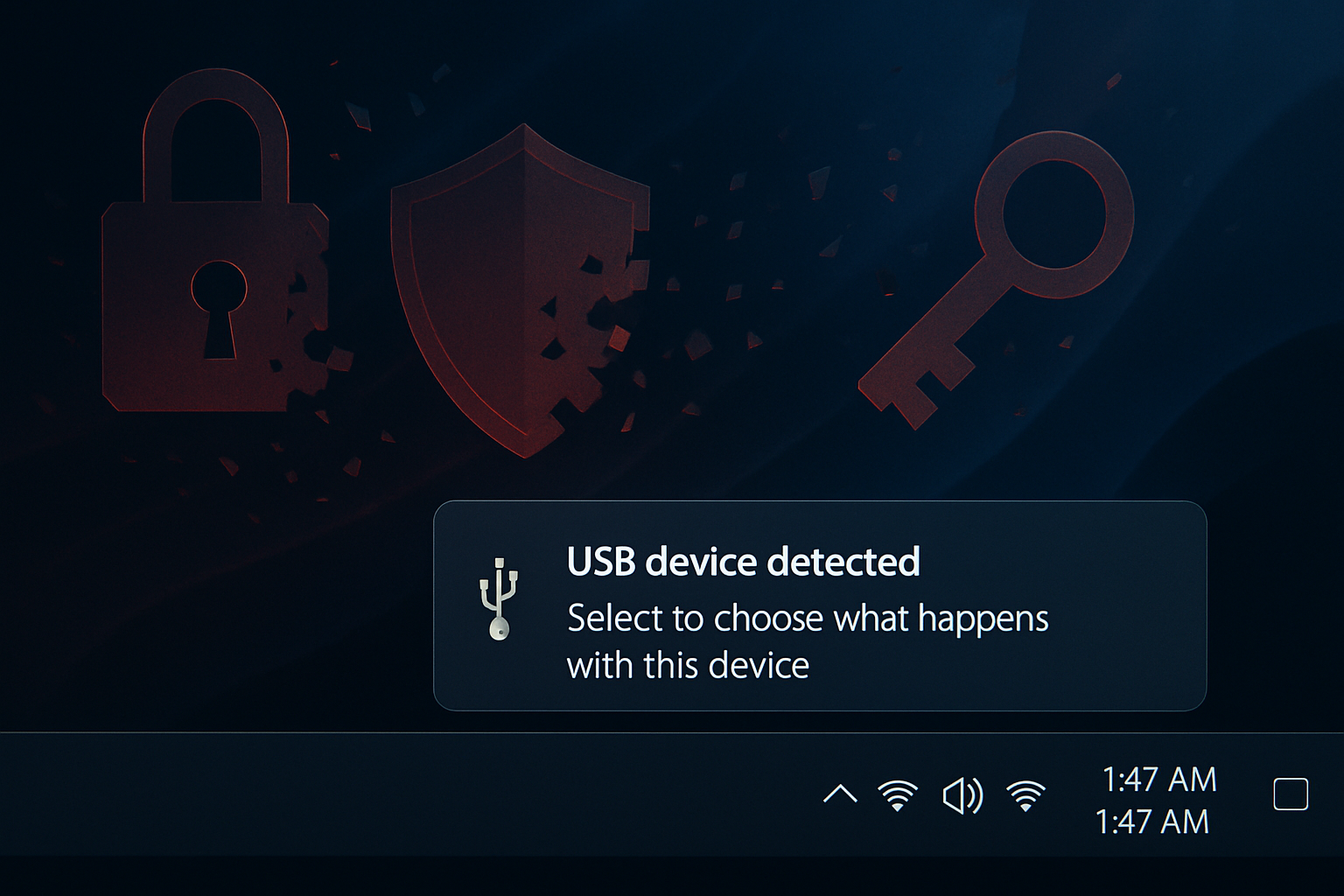
A recent security disclosure has revealed a troubling privilege escalation path in Windows Plug and Play (PnP) that allows unauthenticated or low-privileged attackers to gain SYSTEM-level access on fully updated Windows 11 machines. The attack chains vendor-signed driver installation with PnP's device enumeration mechanism—a design decision that prioritises user convenience over granular access control.
How the Attack Works
Windows Plug and Play is designed to automatically detect and install hardware drivers when a new device connects. The operating system trusts Microsoft-signed publisher certificates and vendor binaries, automatically fetching and executing installation code with elevated privileges. Researchers discovered that by emulating a USB device and triggering the PnP discovery flow, an attacker can force Windows to fetch legitimate, signed vendor software and abuse the installation routine to execute arbitrary code as SYSTEM.
The critical flaw lies in how Windows handles device driver installation without requiring explicit user consent for privileged operations. The PnP subsystem treats vendor-signed binaries as trustworthy by default, skipping several validation steps that would normally gate access to system-level APIs.
Even more concerning, the same attack surface exists over Remote Desktop Protocol (RDP) when Plug and Play or USB device redirection is enabled—a common configuration in enterprise environments. An attacker with RDP access does not need physical hardware; they can trigger the exploit entirely through software-based device emulation.
Implications for Infrastructure and Server Security
For organisations running Windows-based infrastructure, this vulnerability creates multiple attack scenarios. Jump boxes, administrative workstations, and Remote Desktop gateways are obvious targets. If an attacker gains initial access to any user session—whether through credential compromise, phishing, or lateral movement—they can escalate to SYSTEM without additional tools or exploitation complexity.
The PnP mechanism is intentionally difficult to disable system-wide without breaking device detection entirely. Administrators attempting to lock down Windows systems must choose between usability and security, a choice that Microsoft has effectively removed by tying the vulnerable code path to core OS functionality.
For hosting providers operating Windows-based infrastructure—whether offering Windows VPS, Remote Desktop services, or managed Windows hosting—this represents a significant patch priority. A compromised admin session or customer gaining RDP access could now escalate to hypervisor-level or host access depending on architecture.
Detection and Mitigation Challenges
Detecting exploitation is difficult because the attack mimics legitimate PnP enumeration. Event logs may not clearly distinguish between a genuine hardware addition and a malicious emulation. Traditional endpoint detection and response (EDR) solutions may miss the attack if they rely on file-write or process-execution signatures—the initial escalation happens entirely within Windows internals.
Mitigation currently depends on applying Microsoft's patches and enforcing stronger access controls around RDP and device redirection. Organisations should audit which users and services have USB device redirection enabled, and disable it wherever it is not operationally necessary. Restricting Plug and Play driver installation to administrator-approved devices via Group Policy provides additional hardening, though this may interfere with legitimate hardware provisioning workflows.
Disabling Remote Desktop or enforcing network-level authentication (NLA) on all RDP endpoints reduces the attack surface significantly. However, neither measure eliminates the vulnerability in scenarios where an attacker already has local access to the system.
Broader Implications for Privilege Escalation in Windows
This disclosure joins a growing body of evidence that Windows' device-driver trust model prioritises compatibility and convenience over security boundaries. Previous attacks have exploited similar assumptions—that signed code and automatic elevation can coexist safely. Each discovery reveals another layer where an attacker can slip between layers of access control.
For infrastructure teams, the lesson is familiar: assume breach. Systems handling sensitive workloads or administrative functions should be segmented so that a single compromise does not grant attacker-controlled SYSTEM access to the underlying host. Where Windows is unavoidable, network isolation and strict access controls matter as much as patching.
Microsoft's response will likely involve tightening PnP's privilege boundaries or requiring additional user interaction for certain driver installations. Until patches are broadly deployed, the priority is identifying and isolating systems where this attack path is most exploitable—particularly those handling privileged workloads or offering remote access.