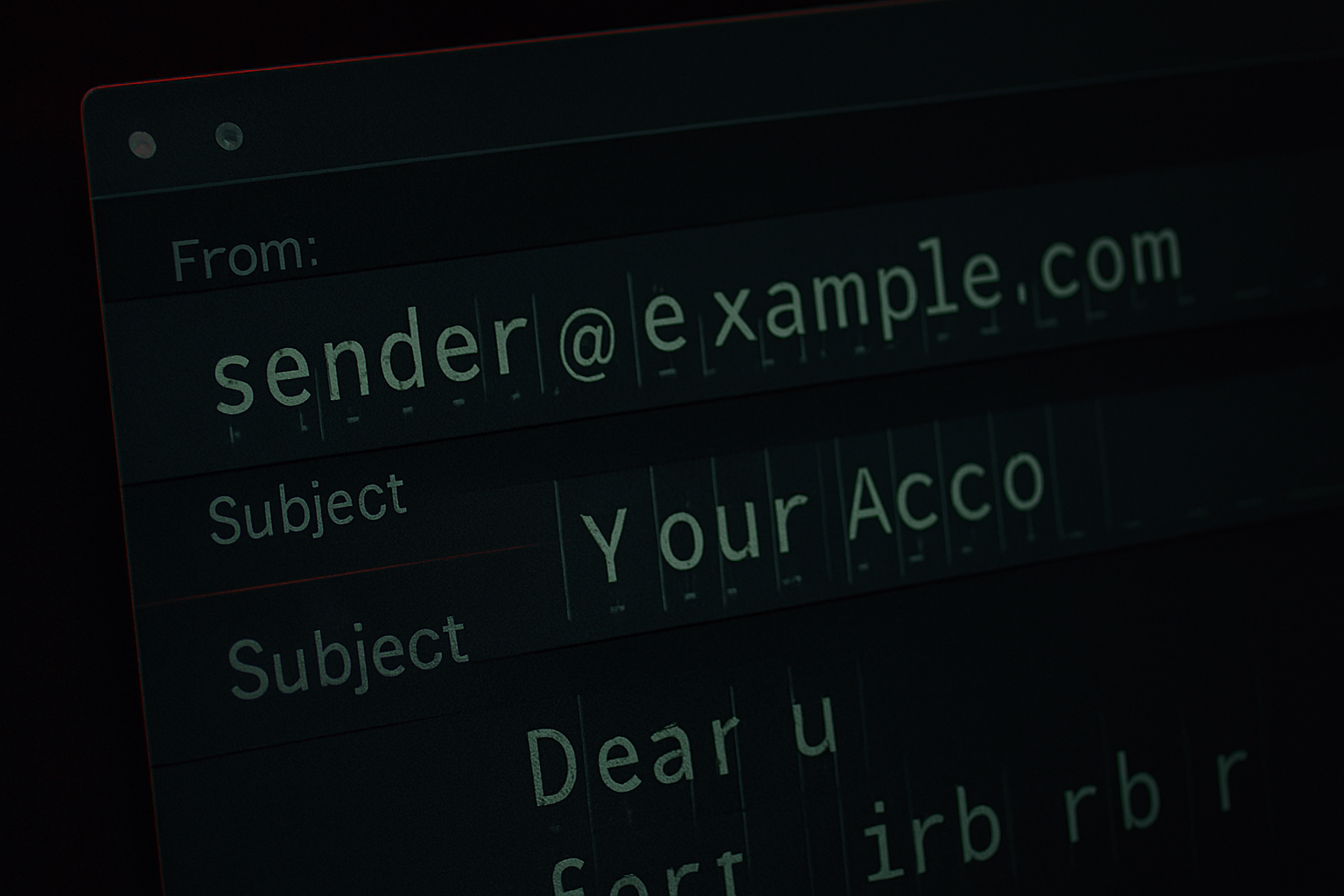
Email filtering has long relied on pattern matching and keyword detection to catch phishing attempts before they reach users. A recent high-volume phishing campaign has exposed a fundamental weakness in that approach: attackers can now splinter recognisable threat indicators using invisible Unicode characters, leaving conventional filters unable to reconstruct the malicious intent.
How the Attack Works
The campaign, documented by Microsoft's Security Research team, employs invisible Unicode tag characters—specifically zero-width joiners and similar formatting glyphs—to break up high-confidence phishing indicators. Instead of sending an email with the word 'funding' intact, an attacker inserts invisible characters between letters: 'funding'. To human readers, the text appears normal. To regex-based and keyword-matching engines, the word no longer exists as a contiguous string.
This technique differs from earlier Unicode evasion tricks, which often relied on homoglyph substitution (using visually similar characters from different scripts) or zero-width spaces to hide instructions from humans whilst exposing them to AI models. Here, the attacker's goal is simpler and more effective: make the filter's job harder by ensuring common lure phrases fragment below detection thresholds.
Why Traditional Filters Miss This
Most email security systems operate in layers. The outer layer checks headers, sender reputation, and basic rules. The middle layer performs content inspection using signature databases and pattern matching. Deeper inspection employs machine-learning models trained on thousands of phishing samples. Unicode obfuscation defeats the middle layer almost entirely because:
- Regex patterns expect unbroken strings. A rule looking for 'funding|investment|wire' will not match if those words are interleaved with invisible characters.
- Normalisation procedures that strip or decode Unicode often miss tag characters, which are valid Unicode entities with legitimate uses in some text processing workflows.
- ML models, if trained primarily on plaintext, may not generalise well to obfuscated inputs if the training set contained few such examples.
The campaign reportedly sent millions of messages, suggesting the technique was effective enough to warrant scale. For infrastructure operators and email administrators, this represents a significant validation gap: the defences deployed a year ago may no longer catch what's being sent today.
Implications for Hosting and Infrastructure Teams
If you operate shared hosting, managed email services, or virtual private servers used for email delivery or receiving, this vulnerability affects you directly. Customers running mail servers will expect your filtering appliances—whether Postfix with SpamAssassin, commercial solutions like Proofpoint or Mimecast, or cloud-native services—to catch these attacks. If your filtering stack doesn't normalise or decompose Unicode before pattern matching, it's now a liability.
The mitigation path involves several layers. First, ensure your email gateway performs aggressive Unicode normalisation (NFKC normalisation is a reasonable starting point, though not a complete solution). Second, train content filters to detect the invisible characters themselves—a simple heuristic for high concentrations of zero-width joiners or tag characters can flag suspicious email before keyword matching even begins. Third, update any custom security rules you've written; if they rely on plain regex, they need Unicode-aware equivalents.
For organisations handling sensitive workflows—financial services, healthcare, legal—this is also a reminder that email alone is not a trustworthy authentication channel. Phishing will adapt faster than filter rules can be written. Supplementary controls such as multi-factor authentication, DKIM/DMARC/SPF alignment enforcement, and user training remain essential.
A Broader Pattern
This campaign reflects a broader trend: attackers are learning that evading automated defences at the character level is far more scalable than evading human judgment. As machine-learning models improve email filtering, attackers shift to obfuscation that breaks the assumptions underlying both legacy and modern detection systems. The Unicode tag character approach is particularly elegant because it's neither a vulnerability in Unicode itself nor a violation of email standards—it's simply a use of the spec in a way filter designers didn't prioritise.
The takeaway for infrastructure teams is that security posture must remain reactive as well as proactive. Monitor threat reports like this one from Microsoft closely, test your filtering stack against obfuscated payloads, and prepare to iterate quickly. Email security is no longer a set-and-forget deployment.