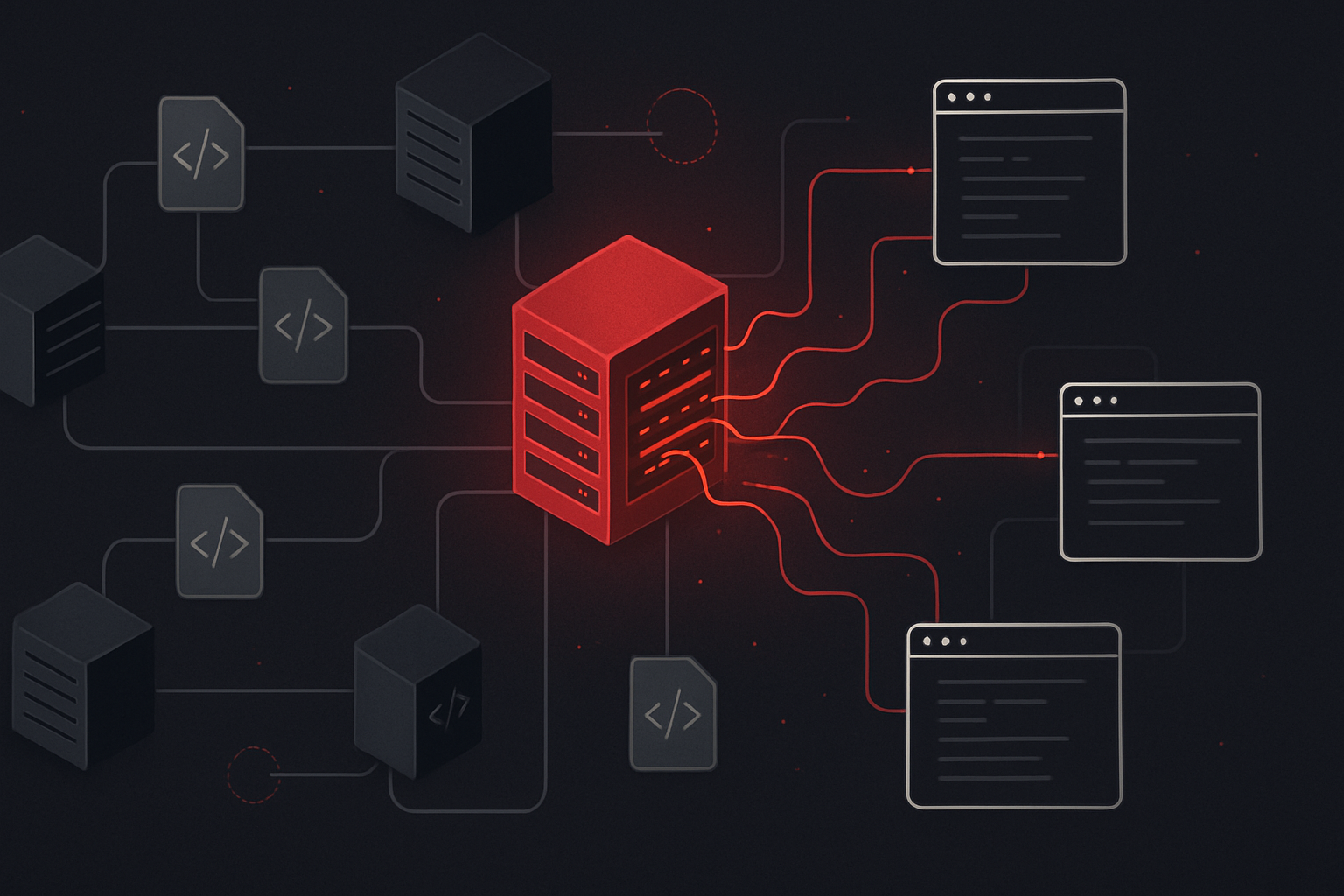
In July 2026, attackers successfully compromised a JavaScript file served by Adform, an advertising technology platform used across thousands of websites. The malicious code rewrote cryptocurrency wallet addresses in real time within users' browsers—converting deposit addresses to attacker-controlled wallets before victims could copy them. The incident was detected and remediated within hours, but it underscores a critical vulnerability in how modern web infrastructure outsources trust.
The anatomy of a third-party compromise
Third-party scripts—whether ad tags, analytics, chatbots, or payment processors—run in the same security context as your site's content. They have DOM access, can read form inputs, and can manipulate the page before it reaches the user's eyes. This trust model made sense when the web was simpler. Today it's a liability.
Compromising Adform's infrastructure meant reaching not one site, but potentially thousands. The attacker didn't need to breach individual hosting accounts or content management systems. One poisoned file in a trusted CDN caused damage across the entire customer base. This is the essence of supply chain risk: you inherit the security posture of every service you embed.
The financial motive here is straightforward. Cryptocurrency transactions are irreversible. A user copying a wallet address from a form field, pasting it into their exchange withdrawal dialog, and hitting confirm has no recourse once funds land in the attacker's account. No chargeback, no dispute process. The attack surface is enormous and the time window is just long enough.
Detection and containment challenges
Adform's rapid response—detection on July 27 and remediation the same day—was competent but hardly exceptional. The real question is how many users had already been compromised before removal. Third-party script attacks are notoriously difficult to detect from the victim's perspective. No certificate warning, no network error, no console message. The page loads normally. The script behaves normally. Only the output is wrong.
For site operators, visibility into third-party script behaviour is limited. You embed a tag from a trusted vendor and trust their security team and their infrastructure. You can't easily audit what code runs or monitor its real-time mutations. Some organisations attempt to use Subresource Integrity (SRI) hashes to lock script versions, but this requires discipline and breaks when the vendor updates legitimately.
Practical defences for infrastructure operators
Hosting providers and site operators cannot eliminate third-party risk entirely, but several strategies reduce exposure:
- Content Security Policy (CSP): Restrict script execution to explicitly whitelisted origins. Disallow inline scripts and eval. This won't prevent a compromised third-party domain from running code, but it prevents attackers from injecting additional scripts or modifying policy.
- Minimal third-party footprint: Each embedded script is a vulnerability surface. Audit your dependencies. Replace ad networks, analytics, and tracking tools with self-hosted equivalents where possible. The performance overhead is often negligible.
- Subresource Integrity: Pin script hashes in your HTML. When a vendor updates, pin breaks your site until you update deliberately. This friction is intentional—it forces awareness of third-party changes.
- Sandboxing sensitive operations: For cryptocurrency, payment processing, or other high-value transactions, isolate input/output in an iframe with restrictive attributes. Limit DOM access from the parent page.
- Regular audits: Review your third-party dependencies quarterly. Check vendor security policies, certifications (SOC 2, ISO 27001), and incident response times. Replace vendors that cannot provide this transparency.
The broader picture
This incident is not an outlier. Ad networks, payment processors, and analytics providers are regularly targeted because of their scale and implicit trust. The Magecart campaigns of recent years followed the same pattern: compromise supply chain, harvest payment data at scale.
Organisations hosting user-facing applications—particularly those handling sensitive operations or financial transactions—cannot treat third-party security as someone else's problem. The infrastructure you control is only as secure as the services you depend on. Maturity in hosting operations now means visibility, accountability, and ruthless minimalism about external dependencies.