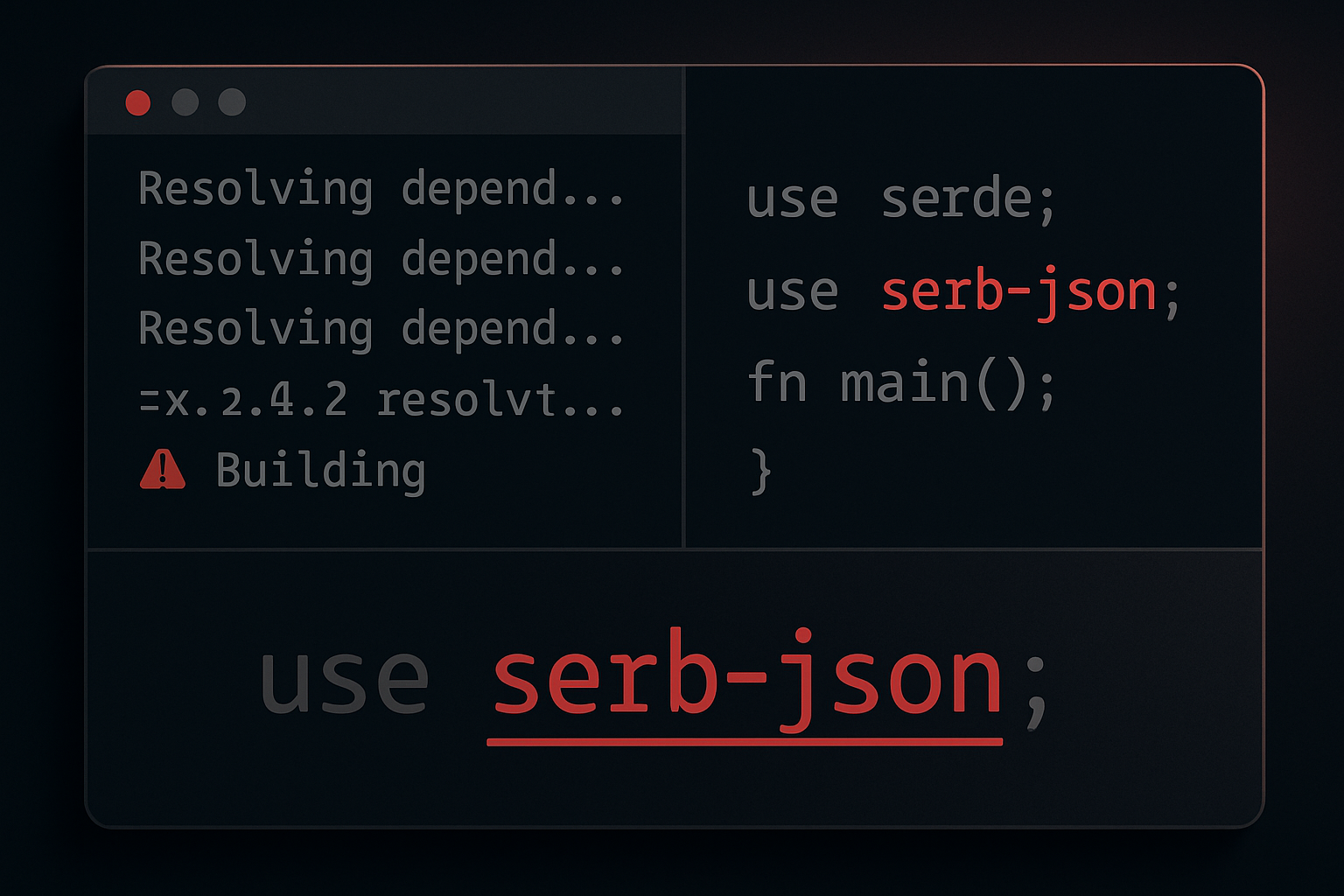
When a maintainer account on crates.io was compromised, the attacker didn't try to hide. Instead, they published new minor releases of arrayref, internment, and append-only-vec—libraries collectively downloaded over 245 million times—each containing a typosquatted dependency that would execute arbitrary code during the build phase. The Rust Project detected and removed the malicious versions, but the incident exposes a critical gap in how we think about dependency security.
Build-Time Execution Is the Overlooked Vector
Most dependency scanning focuses on what code ships in production binaries. But Rust build scripts—invoked during compilation via build.rs—run with the full privileges of the developer or CI/CD system that triggered the build. A malicious build script can exfiltrate secrets from environment variables, steal SSH keys, inject backdoors into the final binary, or establish persistence on the build machine itself.
The attack here was deceptively simple: introduce a typosquatted crate name (slightly misspelled to look legitimate) as a new dependency, then execute whatever payload the attacker wanted when that crate's build script ran. By using established, trusted libraries as the carrier, the attackers maximised distribution without needing to compromise the entire ecosystem.
The accounts affected were real maintainer credentials. This suggests either password reuse, phishing, or compromise of an older system where the developer reused credentials—reminders that even senior contributors can fall victim to conventional social engineering.
Why Minor Version Bumps Bypass Casual Inspection
The attacker chose to publish new minor releases (e.g., 0.3.10 rather than 0.3.9). In many dependency pinning schemes, these updates are automatically pulled in during builds, especially if a Cargo.toml specifies a caret requirement like arrayref = "^0.3.9". Developers often don't review changelog diffs for patch and minor updates the way they would for major version changes.
This automation is a feature—it keeps projects up to date with bug fixes and security patches without constant manual intervention. But it also creates a window where poisoned code can reach thousands of builds before detection, particularly if the library is used as a transitive dependency buried deep in the tree.
Detection and Audit Strategies for Infrastructure Teams
Teams that build Rust services or maintain Rust dependencies should implement several layers of scrutiny:
- Lock file review in CI/CD. Commit
Cargo.lockto version control and verify it in CI before proceeding. Any unexpected changes to locked versions should halt the build. - Audit new transitive dependencies. Tools like
cargo treeshow the full dependency graph. Periodically print it and flag any new crates that were pulled in indirectly. - Restrict or sandbox build scripts. Some projects disable build scripts entirely in certain contexts. Others run builds in containers with limited network access and monitor outbound connections.
- Monitor crates.io yanks and security advisories. The RustSec Advisory Database catalogs known vulnerabilities, and crates.io publishes yanked versions. Subscribe to updates or integrate them into your dependency checker.
- Code review for new and updated direct dependencies. At minimum, skim the changelog and diff for any library you explicitly depend on, especially if a version jump is unusual.
The Broader Lesson: Provenance Matters
This attack underscores why infrastructure teams should care about software provenance—the documented origin and history of each component. In languages with mature package ecosystems, maintainer account compromises are inevitable. The question is whether your build process is designed to detect when something suspicious lands in your dependency tree.
For teams managing hosted services, offshore infrastructure, or production systems, this incident is a reminder to audit your Rust supply chain now, not after a breach. Establish baselines for your dependency trees, automate checks for unexpected changes, and ensure that your build environment is isolated from production credentials.