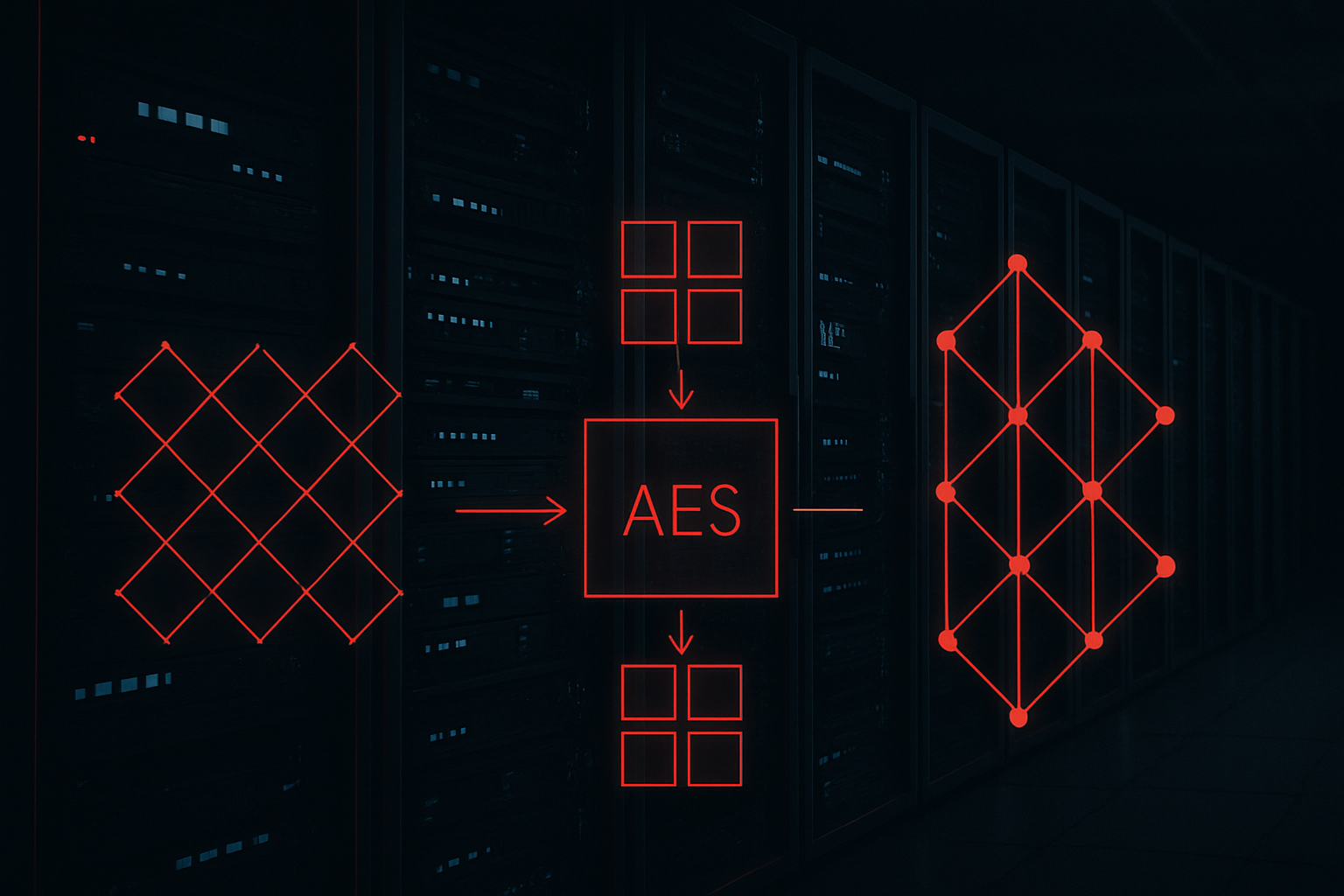
The discovery that AI systems can rapidly identify previously unknown weaknesses in post-quantum cryptography candidates has forced the security community to reconsider migration timelines and algorithm selections. Recent work by Anthropic demonstrated that Claude could derive a complete key-recovery attack against HAWK-256 and substantially accelerate attacks on reduced-round AES variants—findings that carry direct implications for anyone managing infrastructure that depends on cryptographic assurances.
Lattice-Based Schemes and Hidden Structure
HAWK is a lattice-based signature scheme proposed as a post-quantum alternative, designed to resist attacks from hypothetical quantum computers. The attack discovered exploits a previously unused symmetry within the underlying lattice structure—a flaw that existed in the scheme's mathematics but had not been spotted during conventional analysis. Rather than a brute-force break, the attack leverages a subtle algebraic property that allowed recovery of the private key.
The implications are significant. Lattice-based cryptography has been the leading candidate for post-quantum standards precisely because it resists known quantum algorithms whilst remaining efficient on classical hardware. If such schemes contain exploitable symmetries that human cryptanalysts can miss, the question arises: how many others remain undiscovered. The Anthropic work suggests that AI systems may be particularly effective at identifying such hidden structures—a capability that cuts both ways for defenders and attackers.
The AES Acceleration Problem
The speedup in attacks on seven-round AES-128 is equally telling. Full AES uses 10 rounds; seven-round variants exist mainly in academic settings and legacy systems. A 200- to 800-fold acceleration in cryptanalysis against a reduced variant does not directly threaten current deployments of full AES. However, it demonstrates that AI-assisted approaches can surface attack vectors that traditional differential and linear cryptanalysis might miss or take far longer to develop.
For infrastructure operators, the concern is not immediate: AES-128 with 10 rounds remains secure under known attacks. The broader signal is that cryptanalytic methods are evolving, and schemes once considered safe may not survive detailed examination by well-resourced adversaries armed with machine-learning tools.
Implications for Migration Strategy
Organisations planning the shift to post-quantum cryptography face a timing dilemma. The National Institute of Standards and Technology has been standardising post-quantum algorithms over the past several years, with the first formal standards expected in 2024–2025. These standards have undergone peer review and public scrutiny far more rigorous than HAWK received. Nonetheless, the HAWK case demonstrates that mathematical subtlety can evade even expert eyes.
Infrastructure providers—particularly those handling sensitive data or offering long-term storage—cannot wait for cryptographic certainty. Harvest-now, decrypt-later attacks remain a real threat for adversaries with the capability to record encrypted traffic and exploit quantum computers in the future. The current best practice is hybrid deployment: running both classical and post-quantum algorithms in parallel, so that breaking one does not compromise the session.
The discovery also highlights the importance of algorithm diversity in any migration. Selecting a single post-quantum scheme and deploying it across all infrastructure would concentrate risk. If a lattice-based signature scheme can fail in one context, others may as well. A sensible approach includes lattice variants (such as those based on Module-LWE), hash-based schemes, and code-based schemes—spreading the assumption burden across different mathematical problems.
Defensive Posture Going Forward
For operators managing hosting, VPS, or dedicated server infrastructure, the lesson is to maintain cryptographic agility. Systems locked into a single algorithm—whether classical or post-quantum—become vulnerable the moment that algorithm weakens. This argues for:
- Regular cryptographic audits of systems handling long-lived data.
- Active monitoring for new attacks and advisory updates from NIST and relevant standards bodies.
- Hybrid or multi-algorithm deployment where practical.
- Transparency with customers about cryptographic posture and migration plans.
The AI cryptanalysis breakthrough is also a reminder that security through obscurity—or even through mathematical complexity—is not assured. The field is moving faster, tools are improving, and assumptions that held for years can crumble quickly once the right analytical lens is applied. For infrastructure providers, that reality demands continuous attention and a willingness to update even when the current systems appear sound.