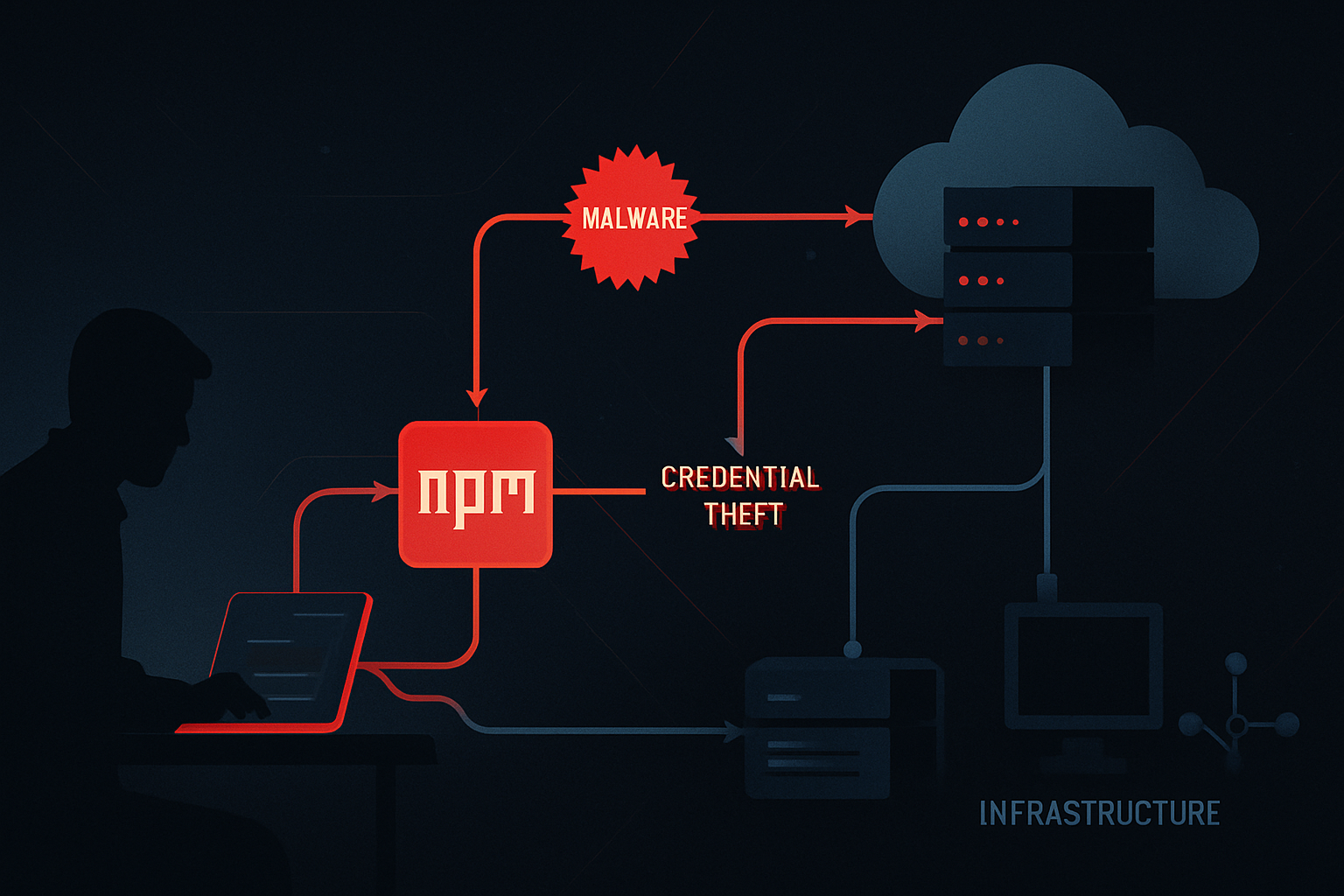
The npm ecosystem has become a preferred hunting ground for supply chain attackers, and recent campaigns underscore how a single compromised dependency can spiral into infrastructure-wide compromise. When threat actors poison package repositories, the blast radius extends far beyond individual developers—affecting build pipelines, CI/CD infrastructure, and ultimately the servers and hosting environments where those applications run.
How Poisoned Packages Reach Production
The attack pattern is now familiar but remains effective. Threat actors identify legitimate, widely-used npm packages, then submit pull requests or gain access through account compromise. Instead of obvious malicious code, they embed their payload in installation scripts or obfuscated dependencies. A developer installs what appears to be a routine update, and the malware executes with the privileges of their shell.
Recent campaigns have distributed both an information stealer and a self-spreading worm across over 50 packages. The information stealer targets the low-hanging fruit: SSH keys, API tokens, cloud credentials, and environment variables stored in plaintext on a developer's machine. A Rust-based implementation suggests sophistication—compiled binaries are harder to reverse-engineer than interpreted scripts, and Rust's performance characteristics suit malware designed to exfiltrate data quickly.
The self-spreading variant introduces additional risk. Rather than simply stealing from a single host, it propagates itself to other packages or systems accessible from the compromised machine. This mechanism transforms a one-time installation into a persistent threat that can establish footholds across multiple projects and infrastructure layers.
The eBPF Rootkit Layer
What distinguishes these campaigns is the use of eBPF (extended Berkeley Packet Filter) kernel instrumentation to hide the malware's presence. eBPF allows code to run in kernel space without loadable kernel modules, making detection significantly harder. Traditional host-based intrusion detection systems may miss activity obscured at the eBPF layer, particularly if the malware is designed to hide its file descriptors, network sockets, or process metadata.
For infrastructure operators, this is a critical distinction. If a developer on your team installs a poisoned package, conventional endpoint monitoring might not catch the rootkit. The malware could establish persistent access, exfiltrate your application's secrets, or pivot toward your deployment infrastructure—all while appearing invisible to standard security tools.
Risk Escalation in Hosting and Deployment
The consequences ripple outward when compromised code reaches production. If a poisoned package is bundled into a Docker image or deployed to a VPS, the attacker gains access to database credentials, API keys for third-party services, and potentially credentials for your hosting provider itself. In shared hosting environments, a compromise in one account could theoretically provide reconnaissance data useful for lateral movement.
The timing of installation matters too. If malware runs during your CI/CD pipeline—building Docker images, deploying to cloud infrastructure, or updating live services—it operates with high privileges. Build systems often have broader access than production containers, making them particularly valuable targets.
Practical Defence Measures
Supply chain attacks at the package level require defence across multiple layers. Dependency pinning—freezing specific versions rather than accepting range updates—slows automatic propagation, though it shifts the burden to manual security reviews. Software composition analysis (SCA) tools scan dependencies for known vulnerabilities, but they're less effective against zero-day poisoned packages.
Credential rotation becomes critical if your team has installed npm packages from untrusted sources. SSH keys, cloud provider tokens, and database passwords should be rotated on any machine that might have executed malicious code. This is tedious but necessary; a single leaked token can outlive the initial infection.
At the infrastructure layer, segregating build systems from production environments limits blast radius. A compromised CI/CD system shouldn't have direct access to production secrets. Using short-lived credentials, credential-less authentication (such as OIDC), and strict IAM policies ensures that even if a secret is stolen, its utility is time-limited.
Network segmentation also matters. If your applications run on dedicated servers or VPS infrastructure, monitor egress traffic for unexpected data exfiltration. Malware that steals credentials will typically attempt to phone home; traffic analysis can catch that even if the rootkit itself remains hidden.
A Persistent Challenge
As JFrog's research highlights, supply chain attacks have become a standard tool for sophisticated threat actors. The npm ecosystem is lucrative because millions of applications depend on it, and a single successful compromise can affect thousands of downstream users. The shift toward rootkit-based hiding and worm-like propagation suggests attackers are investing in evasion and automation.
For anyone running applications on hosted infrastructure, the takeaway is straightforward: trust no dependency blindly, assume your keys could leak, and design your infrastructure so that leaked credentials grant minimal access. The npm repository itself has strong security practices, but no repository is immune to social engineering or account compromise. Defence must assume the supply chain will be poisoned occasionally—and ensure your infrastructure can survive that poisoning without total compromise.