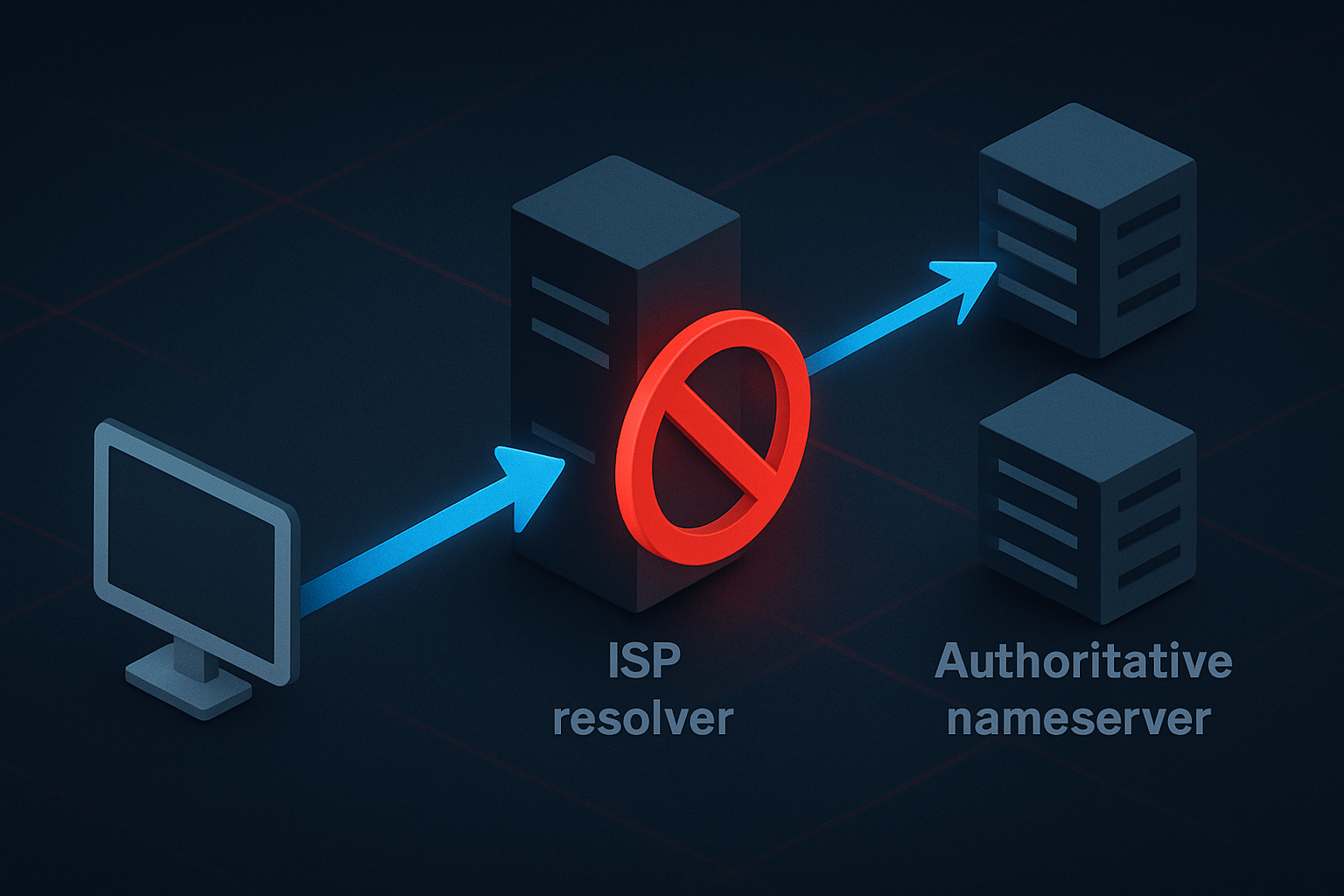
Recent legislative proposals in the U.S. Congress would require Internet Service Providers and DNS resolvers to actively block access to foreign piracy sites. While framed as copyright protection, the technical implementation raises significant concerns for infrastructure operators and the broader DNS ecosystem.
How DNS-Level Blocking Would Work
A site-blocking mandate typically operates at two layers. ISPs would be required to intercept DNS queries for listed domains and return null or redirect responses, preventing resolution to the target IP address. DNS resolver operators—both large public services like Cloudflare's 1.1.1.1 and ISP-operated resolvers—would face similar obligations.
The appeal to legislators is straightforward: blocking at the DNS layer happens before an HTTP request is ever made, creating an apparent barrier without requiring deep packet inspection or explicit content analysis. However, this approach introduces several architectural problems. DNS is a fundamental protocol; once you establish filtering at that layer, you've created a precedent and infrastructure for blocking that can be repurposed for any claimed objective—copyright, national security, public health, or political speech.
Collateral Damage and Overblocking
One of the most persistent issues with DNS blocking is overblocking: legitimate services hosted on shared IP addresses or CDNs get collateral-blocked when a single domain on that infrastructure is targeted. A piracy site might operate from the same cloud provider, reverse proxy, or CDN as thousands of lawful services. Blocking the domain often requires blocking an entire subnet or service provider.
Worse, DNS-based blocking is trivial to circumvent. Users switch to alternative resolvers (8.8.8.8, 1.1.1.1, or offshore providers), use VPNs, or simply query nameservers directly. The blocking doesn't prevent determined access—it merely inconveniences casual users while creating the false impression of enforcement. This gives copyright holders a psychological win without actually stopping infringement, all while imposing ongoing compliance costs on ISPs and resolver operators.
DNSSEC Validation and Security Fragmentation
Mandatory DNS filtering creates a deeper problem: it incentivises users to abandon DNSSEC validation. DNSSEC is a cryptographic extension that verifies DNS responses haven't been tampered with. If an ISP's resolver is returning fake responses (blocking pages), DNSSEC validation will fail, and users have to disable it. This erodes the security of the DNS system itself, making users more vulnerable to cache poisoning and man-in-the-middle attacks.
Infrastructure operators also face implementation choices. Some will use NXDOMAIN (returning no such domain), others will redirect to informational pages, and some may blackhole queries entirely. This fragmentation means a pirate site isn't uniformly blocked—different users see different behaviours depending on their ISP and resolver. The technical inconsistency undermines the stated goal while creating debugging nightmares for legitimate DNS administrators.
Jurisdiction and Extraterritorial Reach
U.S.-based ISPs and DNS resolver operators already face pressure from copyright holders to block content. A legal mandate simply formalises what is already a commercial reality in many cases. The real issue is that DNS blocking extends U.S. law enforcement into the global DNS infrastructure. Non-U.S. operators of public DNS resolvers would face pressure to comply with U.S. blocking lists or risk being blocked themselves, effectively extending American copyright jurisdiction worldwide.
This creates tension for offshore infrastructure providers and privacy-focused DNS operators. A competing site-blocking bill suggests internal disagreement on approach, but the underlying principle—DNS-level filtering mandates—remains technically problematic regardless of which version advances.
A Better Path Forward
Rather than layer filtering obligations onto DNS operators, more effective approaches exist: targeting payment processors and ad networks (where piracy sites derive revenue), prosecuting operators in jurisdictions where that's feasible, or working with hosting providers to remove infringing content at source. These approaches address root causes without fragmenting DNS security or creating false compliance theatre.
For operators running offshore hosting or privacy-focused infrastructure, understanding these legislative trends is essential. Blocking mandates will likely expand, and deciding how to respond—whether to comply, relocate services, or implement technical countermeasures—requires clarity on the actual mechanics and risks involved.