
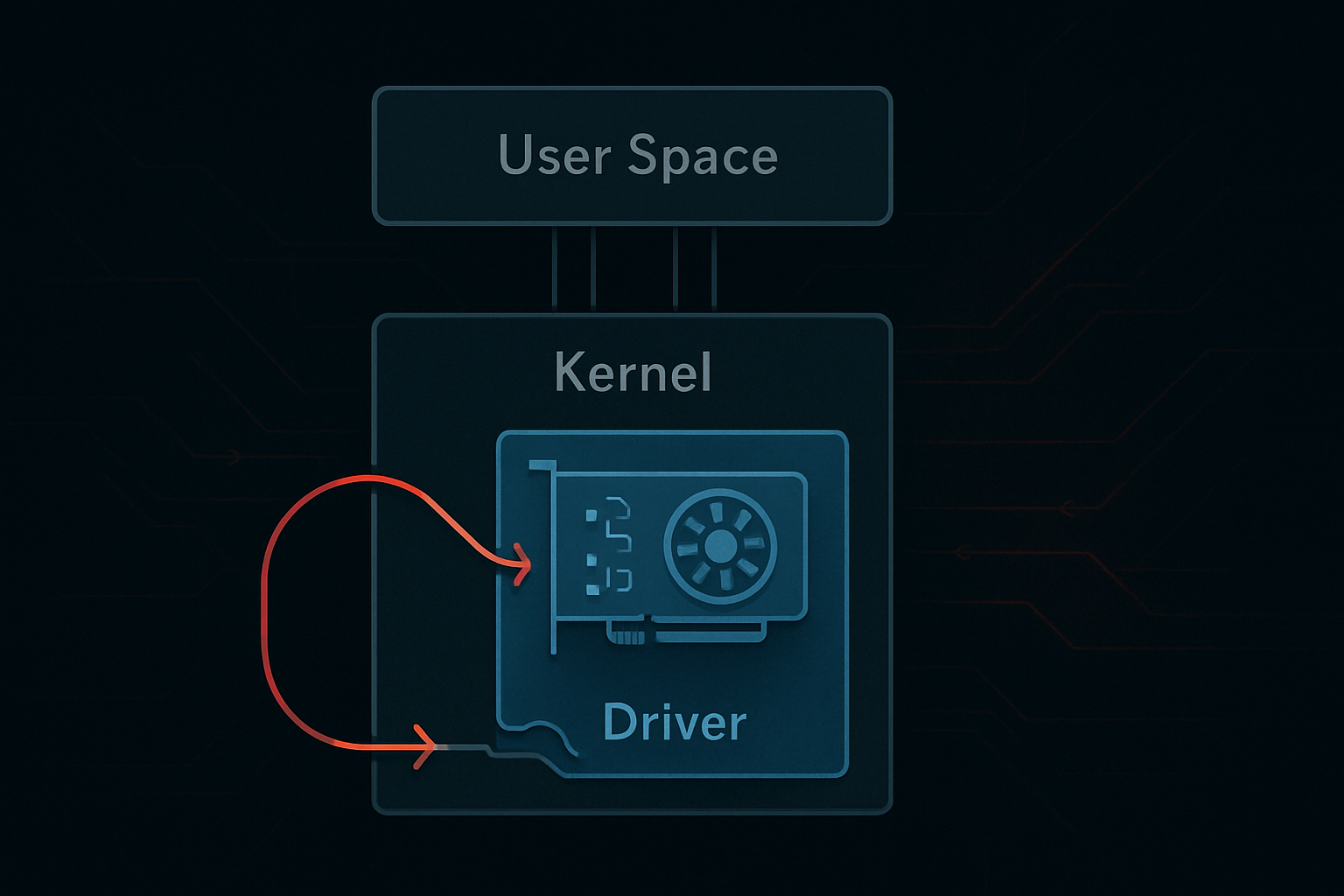
Malware operators have long sought ways to operate beneath the detection threshold of security software. A recent analysis of the Lunex stealer malware family reveals a particularly effective approach: abusing legitimate, signed drivers to disable or interfere with security monitoring at the kernel level. This technique highlights a fundamental asymmetry in endpoint defence—legitimate software often has more privileged access than the security tools meant to protect it.
The Driver Abuse Pattern
The Lunex malware campaign, documented by security researchers tracking the malware-as-a-service operation, leverages a legitimate AMD driver to suppress or disable endpoint security mechanisms. This is not a novel concept in principle—driver abuse has been used in rootkits and advanced persistent threats for years—but its integration into a commoditised malware service suggests the technique has matured into a reliable operational primitive.
The attack chain begins with social engineering, typically via fake CAPTCHA verification pages or ClickFix-style phishing that tricks users into downloading the initial payload. Once executed, the malware uses staged deployment to load a legitimate, signed driver. Because the driver carries a valid signature, it bypasses many driver-signing requirements and kernel security checks. The malware then abuses this driver's functionality—often privileged I/O or memory access—to interfere with user-mode security software or disable kernel-mode protection features.
What makes this approach effective is that the driver itself is not malicious; it is merely being weaponised. This significantly complicates detection. Endpoint detection and response (EDR) tools monitoring driver loads will see a signed, legitimate binary. Behavioural analysis must then determine whether the driver is being abused—a harder problem than identifying outright malicious code.
Why Kernel-Level Access Matters
Modern security software operates at multiple privilege levels. User-mode antivirus and EDR tools can be killed or neutered by malware running with administrative privileges. Kernel-mode drivers, by contrast, can intercept system calls, monitor process creation, and access memory that user-mode tools cannot. When malware gains kernel-level control—even indirectly, by abusing a legitimate driver—it gains the ability to blind security software from below.
This asymmetry is why driver abuse is so valuable to attackers. They do not need to write their own kernel exploit or patch; they borrow a legitimate one. The Lunex operation's use of an AMD driver likely reflects convenience and prevalence rather than a specific technical advantage of that driver over others. AMD drivers are common on many systems, especially those with Ryzen processors, making them a reliable vector.
Defensive Implications
Organisations looking to harden endpoints against this class of attack face several challenges. At the organisational level, user training to recognise phishing and fake CAPTCHA pages remains essential—the attack chain begins with social engineering, and no amount of kernel hardening stops a user who voluntarily downloads malware.
At the technical level, driver-level monitoring becomes critical. Many organisations rely on driver load policies and digital signature verification, but these are necessary rather than sufficient controls. Kernel-mode security software that monitors driver behaviour during execution—detecting suspicious I/O patterns, memory access, or inter-process communication—can catch abuse even when the driver itself is legitimate.
Some modern approaches include driver-signing policy enforcement that whitelists only drivers known to be necessary, and driver load event logging that feeds into security information and event management (SIEM) systems. Disabling or removing drivers that are not needed for operation reduces the attack surface available for abuse.
Patching and driver updates also matter. If the underlying driver has a known vulnerability—such as an unprotected I/O control (IOCTL) interface—applying vendor patches can close the avenue of abuse. However, in zero-day or unpatched scenarios, organisations may need to disable or block the driver entirely, accepting the loss of any features it provides.
A Reminder of Asymmetric Privilege
The Lunex stealer campaign underscores a persistent challenge in endpoint defence: attackers with kernel-level access have privileged positions that user-mode security tools struggle to counter. Legitimate drivers—signed, prevalent, and often overlooked in security policies—become vectors for that privilege. Defending against this requires both user awareness and technical controls that operate at the same privilege level as the threat: the kernel itself.


