
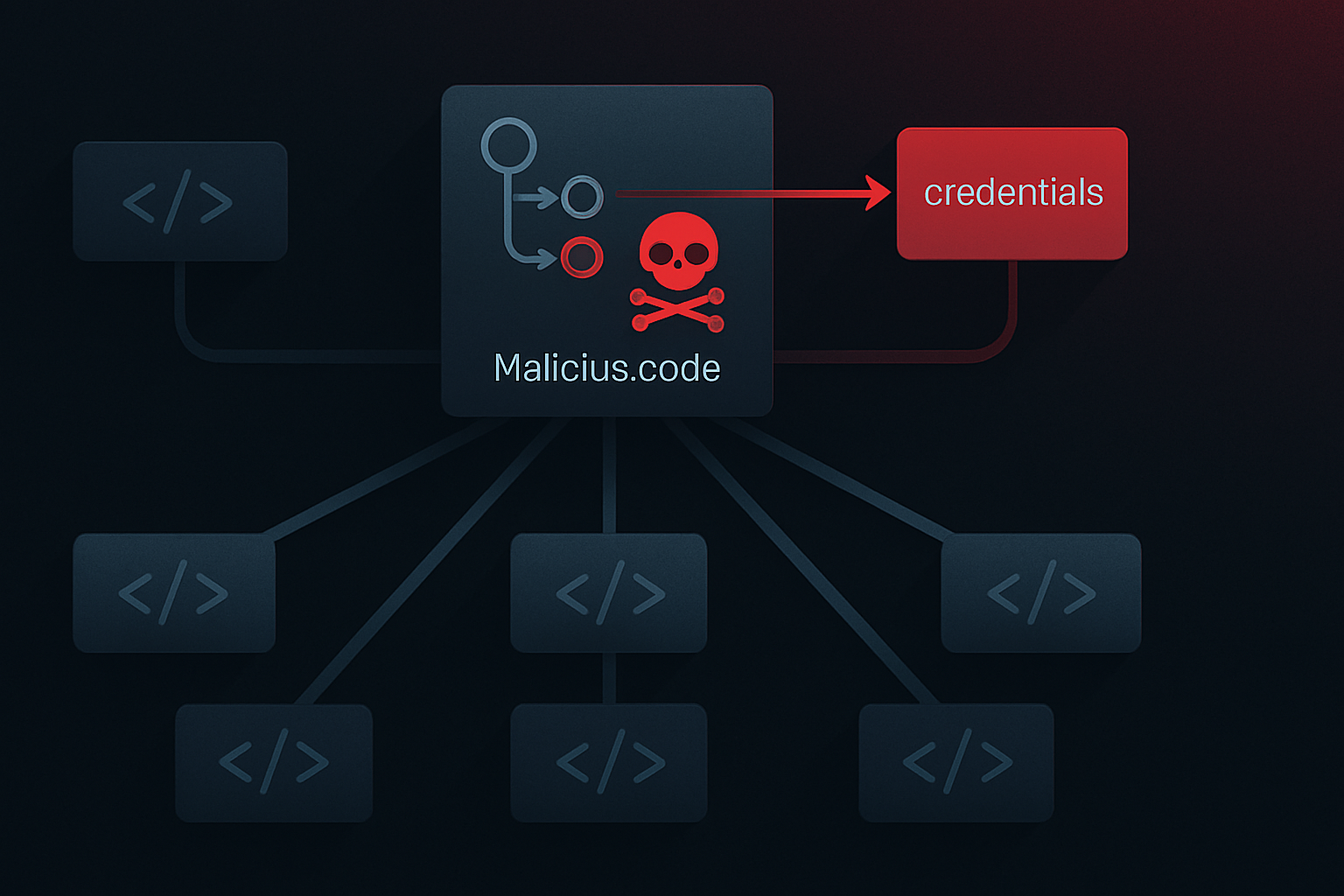
Recent research has documented a credential-theft campaign that exploited compromised maintainer accounts to inject malicious GitHub Actions workflows into over 340 repositories. The attack leveraged high-profile open-source project ownership to distribute workflows that harvested secrets and credentials. This incident illustrates a critical vulnerability in modern software supply chains that extends well beyond the immediate victims.
How the Attack Propagated
The campaign operated by gaining control of established maintainer accounts—individuals with sufficient repository permissions to modify workflow definitions without raising immediate suspicion. Once inside, attackers pushed malicious .github/workflows files that would execute during pull request events or scheduled triggers. Because these accounts had existing reputation and contributor history, the changes appeared legitimate at first glance.
The attack vector is particularly effective because workflow files are code; they run with repository secrets and environment variables exposed to the execution environment. An attacker can exfiltrate credentials, API tokens, deployment keys, and database passwords with a single workflow step. The open-source ecosystem compounds the risk: thousands of downstream projects may depend on a compromised library or tool, creating a multiplier effect.
Why Traditional Access Controls Aren't Enough
Many organisations and open-source projects rely on single-factor authentication or reused credentials across multiple systems. Once an attacker obtains a maintainer's GitHub credentials—through phishing, password reuse, or compromised device—they gain immediate workflow modification privileges. Standard branch protection rules often exempt administrators from review requirements, allowing rapid deployment of malicious code.
A compounding issue is that workflows execute in ephemeral environments where logging and audit trails may not persist. Even if a compromise is detected hours or days later, the exfiltrated secrets have already been used. For projects hosting on shared infrastructure or relying on shared build agents, the blast radius extends further.
Hardening Your Workflow Environment
Several practical steps reduce exposure. Enable branch protection for all branches that contain workflow definitions, and require pull request reviews even for administrators. Use GitHub's environment secrets feature to restrict credential access to specific workflows and deployments. Consider scoping credentials tightly: rather than reusing a single master API key, generate workflow-specific tokens with minimal required permissions.
Implement OIDC token-based authentication where possible, which allows external services (CI runners, deployment targets) to obtain short-lived credentials without storing long-lived secrets in your repository. Review audit logs regularly and monitor for unexpected workflow modifications. If your infrastructure depends on self-hosted runners, isolate them on separate networks and restrict their access to production credentials.
For teams deploying to hosted infrastructure, ensure that your hosting provider supports secret rotation and audit logging. StepSecurity's disclosure emphasises the need for continuous monitoring of workflow execution and immediate revocation of any compromised credentials across all dependent systems.
The Broader Supply Chain Risk
This campaign exposes how open-source maintenance has become a high-value attack target. A single compromised account can inject malicious code into thousands of downstream projects. Enterprises depending on open-source libraries should treat their software bill of materials (SBOM) with the same vigilance as their infrastructure. Periodic review of transitive dependencies and their build practices is no longer optional.
The incident also underscores why infrastructure teams managing deployment pipelines must treat CI/CD systems with the same security rigour as production servers. A compromised workflow can bypass code review, introduce backdoors, or exfiltrate sensitive data before it reaches deployment. If your hosting or deployment infrastructure lacks strong separation between build and runtime credentials, now is the time to remediate.
The attack demonstrates that credential theft at scale is most effective when it operates within trusted channels. Maintaining workflow integrity requires not just technical controls, but a systematic approach to secret management, access isolation, and continuous audit. Organisations hosting open-source projects or running internally managed CI/CD infrastructure should review their current posture against this threat model.


