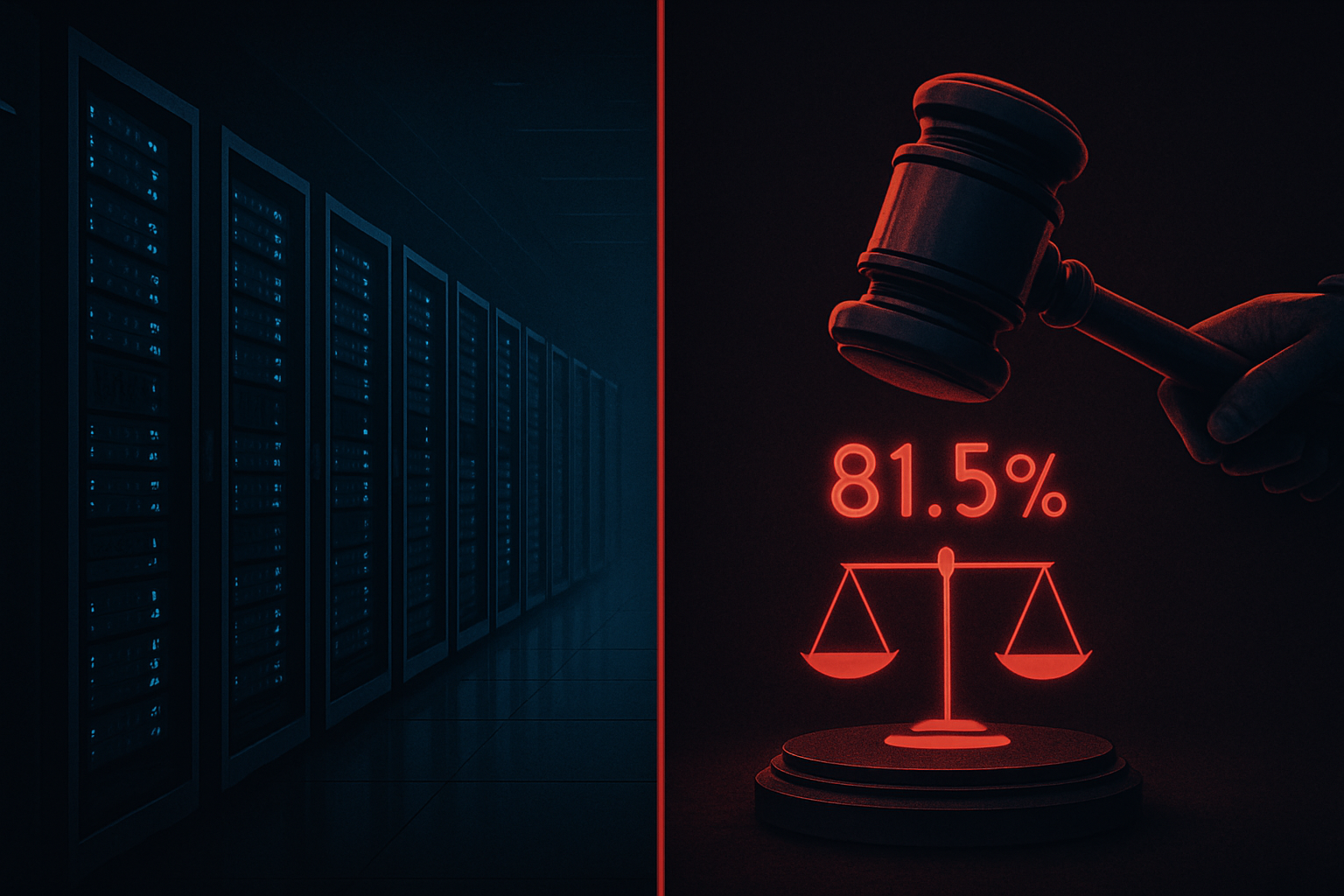
For years, European copyright enforcement operated without a clear metric. A platform hosting infringing material faced blocking orders, but the legal reasoning often remained opaque—was it 60% illegal content, 90%, something else? A recent German court decision has begun to change that, establishing what may become a precedent for how jurisdictions measure structural infringement.
The 81.5% Benchmark
Germany's CUII (Clearinghouse for Copyright and Internet Information) recently concluded that when illegal content comprises at least 81.5% of a platform's library, the site's primary function is demonstrably infringing. This threshold is significant because it moves copyright enforcement away from subjective judgement toward a quantifiable standard. The KinoGO blocking—which was executed at a floor of 82.4% illegal content—appears to be the first major enforcement action anchored to this benchmark.
The number itself tells a story. It's not 99%, not 70%—it's specifically 81.5%, suggesting careful calculation by legal analysts. Whether that precision comes from case law analysis, statistical sampling of content libraries, or a combination of methods remains unclear. What matters operationally is that platforms and hosters now have a numerical target, even if it originated in German law.
The Padding Problem
The decision raises an immediate technical and commercial question: what prevents a platform from simply padding its catalogue with licenced or public-domain content to drop below the threshold? If a site is 82% infringing, adding a large legal library could theoretically push that to 79%, falling below the benchmark and complicating takedown logic.
This isn't hypothetical. A platform operator, knowing the 81.5% line, could license a block of content—older films in public domain, for instance, or cheaper licences for independent work—and inflate their total catalogue without removing a single infringing file. From a hoster's perspective, this raises uncomfortable questions about compliance: does a court order against a platform apply to its entire infrastructure, or only to the infringing fraction? If a blocking order is lifted due to remediation that's purely statistical, what does that mean for network-level enforcement?
Implications for Hosting and Jurisdiction
For hosters, particularly those in jurisdictions with strong DMCA or European enforcement frameworks, this decision signals a shift toward measurable liability. If Germany establishes 81.5% as a meaningful benchmark, other European courts may adopt similar reasoning. This creates a new compliance landscape: hosters must not only respond to copyright notices but potentially monitor their hosting customers' content ratios.
The decision also highlights why jurisdiction matters. A German court can impose numerical standards, but enforcement depends on ISPs, CDNs, and domain registrars cooperating. An offshore hosting provider in a jurisdiction with minimal DMCA compliance or weaker copyright enforcement mechanisms might face blocking orders that never reach them—or, conversely, might find themselves caught between conflicting legal standards if they serve both German and non-compliant customers.
For platforms hosted across multiple jurisdictions, the real risk is inconsistency. A site banned in Germany for exceeding 81.5% illegal content might remain accessible in jurisdictions with higher thresholds or different standards. That fragmentation is expensive to manage and creates liability exposure.
What Comes Next
The KinoGO case is unlikely to be the last time this threshold is tested. If platforms begin padding their catalogues with legal content to skirt the benchmark, copyright holders will petition courts to refine the standard—perhaps measuring unique infringing works rather than total files, or weighting content by user access patterns rather than library size. The law, as always, will chase technical workarounds.
For hosting infrastructure teams, the practical takeaway is straightforward: numerical standards are coming, and they will be enforced. Understanding how your jurisdiction measures infringement, documenting your content moderation practices, and maintaining clear audit trails of compliance efforts is no longer optional. The era of vague copyright enforcement is ending, replaced by specific, measurable benchmarks that hosters and platforms must navigate carefully.