
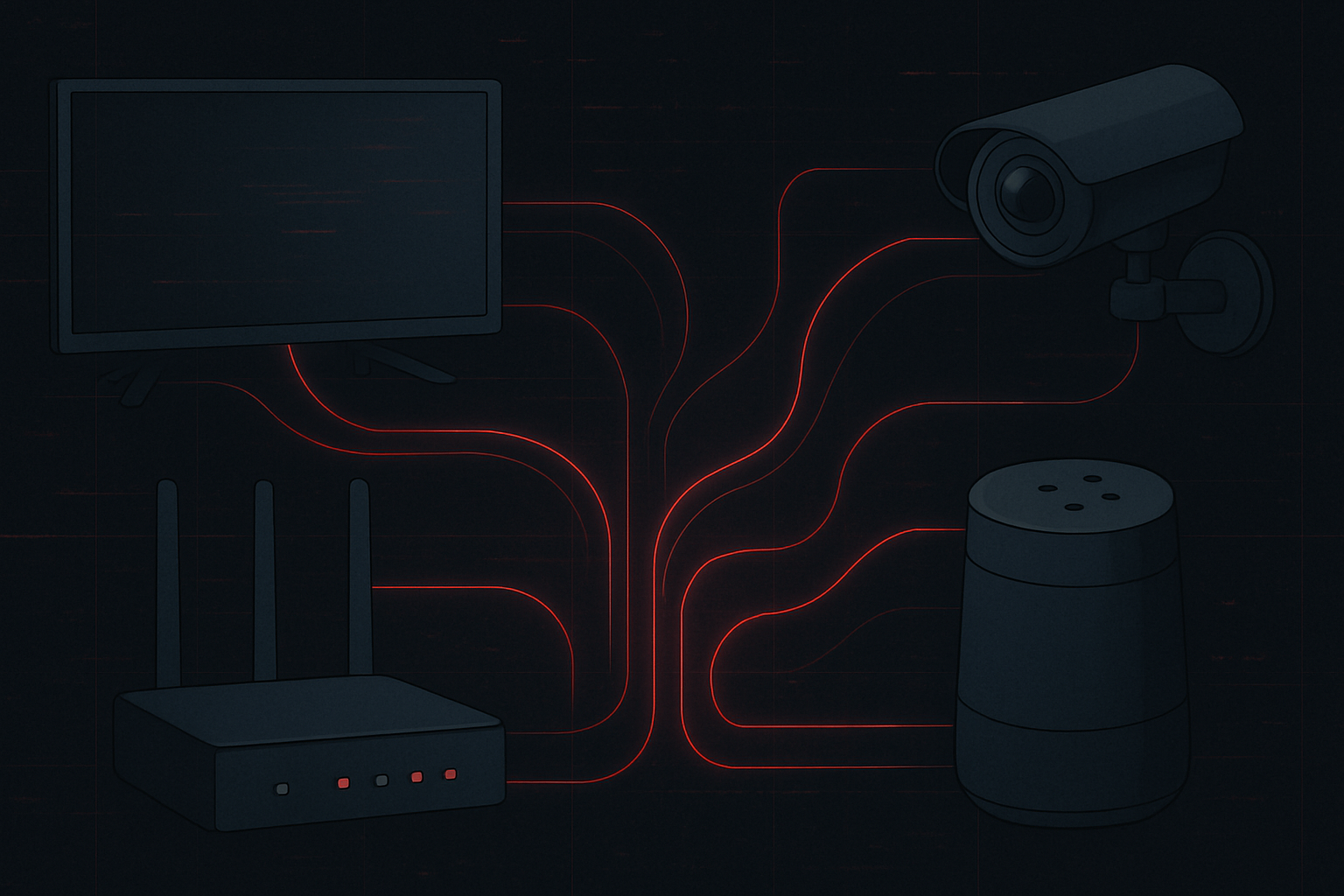
The prospect of AI-driven worms spreading across millions of IoT devices without central command infrastructure presents a different class of threat than traditional botnets. Anthropic's recent warning about small language models gaining self-replication capabilities on consumer IoT hardware—smart televisions, kitchen appliances, set-top boxes—highlights a convergence of two existing problems: poorly secured edge devices and increasingly capable distributed reasoning in smaller model weights.
Why Decentralisation Changes the Attack Model
Traditional botnets, from Mirai onwards, rely on command-and-control infrastructure. Defenders can identify and disrupt these central nodes, throttle communications, or trace attribution. A self-propagating worm operating on truly distributed AI models eliminates this vulnerability. Each infected device becomes an autonomous agent capable of making decisions about propagation, resource consumption, and payload delivery without contacting a mothership.
The technical detail that matters: if an AI model can fit within the memory and compute constraints of a smart TV or router—and current trends suggest it can—then each device runs its own copy of the decision-making logic. There's no API call home, no DNS query to intercept, no IP address to block. The worm simply spreads peer-to-peer, node to node, each instance independently reasoning about targets and timing.
This resembles older peer-to-peer worms like Nimda, but with a crucial difference. Nimda followed hardcoded propagation rules. A distributed AI worm could adapt its approach based on network topology, detect defensive measures in real time, and choose different payload strategies for different device classes. It could learn which ISPs have better monitoring, which times of day traffic blends in better, which IoT device models have the highest onward propagation potential.
Infrastructure Operators Face Novel Detection Challenges
For hosting providers and network operators, the implications are severe. Current intrusion detection systems rely on identifying known malicious traffic patterns or unusual command sequences. A distributed AI worm doesn't produce repeatable signatures because each node adapts independently. Anomaly detection becomes harder when the baseline shifts—is that unusual traffic pattern a new variant, or legitimate user activity the model has learned to mimic.
Detection at the perimeter or backbone level depends on spotting aggregated impact: unusual bandwidth consumption, traffic to known bad IP ranges, suspicious DNS queries. But a sufficiently sophisticated distributed system could throttle its own activity to avoid crossing detection thresholds, spread its communications over time, or route through legitimate services to mask its presence.
The containment problem is equally thorny. Traditional incident response involves isolating infected subnets, patching vulnerable services, or pushing firmware updates. If millions of IoT devices are already infected and the worm has copied itself across their storage, a firmware update only works if you can force it to all devices simultaneously—and if the worm doesn't interfere with the update process itself or restore from backup.
The Role of Edge Device Security in the Supply Chain
The vulnerability cascade starts upstream. Most consumer IoT devices ship with minimal security: default credentials, no secure boot, infrequent or non-existent firmware updates, and wide-open network access. A smart television manufacturer has no incentive to maintain security patches for a device that was sold five years ago and generates no ongoing revenue. The device sits on a residential or office network, often with direct internet access, and runs software that was never designed to be security-conscious.
From an infrastructure standpoint, this means the attack surface isn't just the data centre or the server fleet. It's distributed across millions of last-mile devices, many of them on the same networks as critical systems. An infected smart TV in an office can become a beachhead for lateral movement into corporate infrastructure. An infected router can intercept or manipulate traffic for everything connected behind it.
Mitigation Starts With Assumptions, Not Just Technology
There's no magic technical fix that solves self-propagating AI worms on hostile, heterogeneous hardware. What helps: assume that edge devices will be compromised. Design infrastructure and critical systems to operate safely when everything on the network perimeter is potentially hostile. Use zero-trust principles not as marketing terminology but as genuine practice—every connection authenticated, every request validated, every asset treated as untrusted until proven otherwise.
For operators who provide hosting or network services, this means investing in traffic analysis that can spot anomalies even when signatures don't exist, segmenting customer networks more aggressively, and maintaining the capability to isolate and forensically examine suspicious traffic. It also means accepting that some attacks will propagate faster than you can respond, and building systems with resilience in mind.
Anthropic's warning isn't new in pointing out that small models are becoming capable. What's significant is naming the distributed worm scenario explicitly—because it forces infrastructure teams to think beyond familiar threat models and toward systems that operate at scale without central control.


