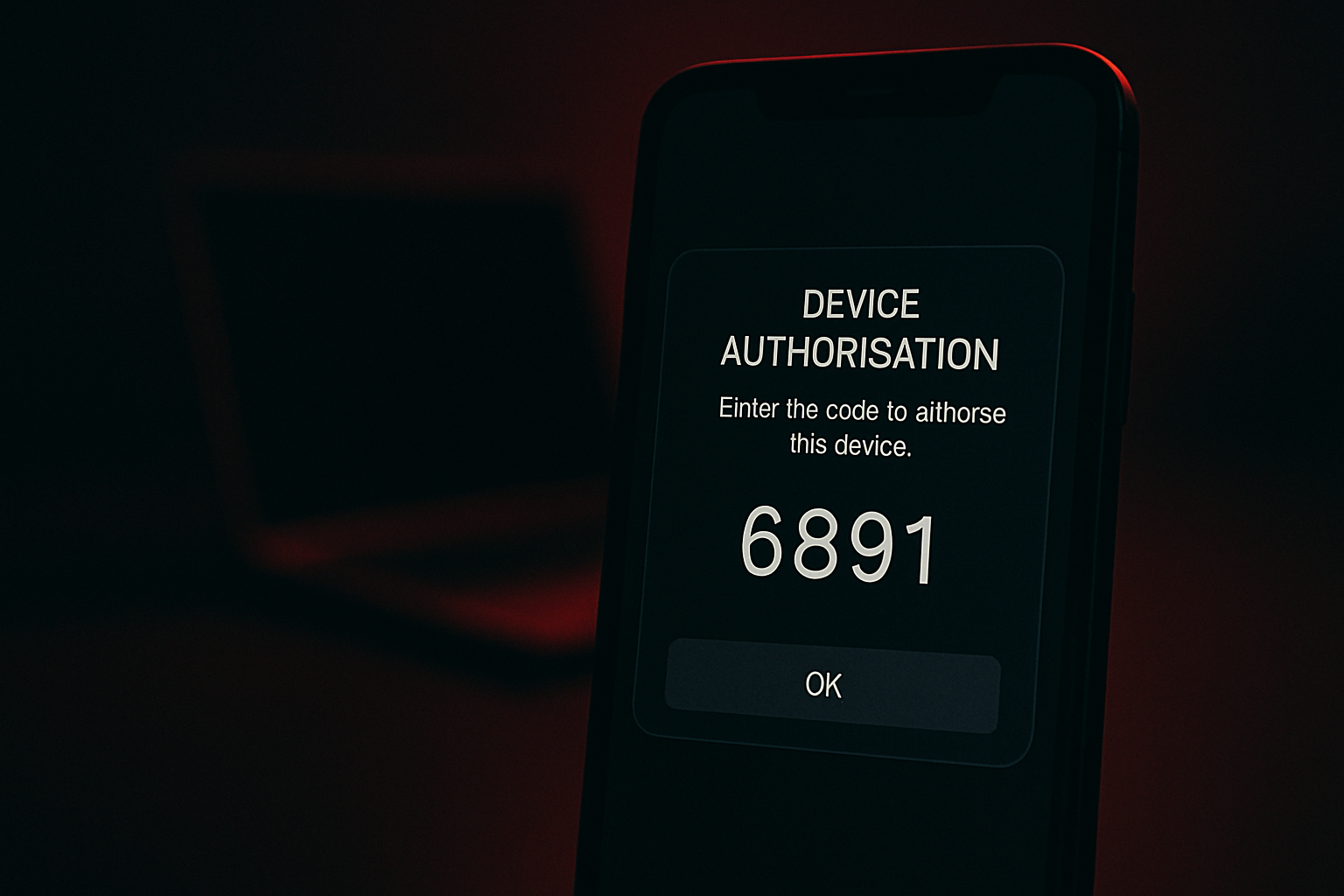
Multi-factor authentication has long been treated as the primary bulwark against credential theft. Yet emerging attack patterns reveal a blind spot: threat actors are now weaponising the very OAuth 2.0 flows that were designed to improve user experience. Device code phishing—now integrated into commercial phishing-as-a-service toolkits like Greatness—demonstrates how a legitimate, convenience-focused authentication mechanism can become a vector for account compromise.
The OAuth 2.0 Device Authorization Grant Problem
The Device Authorization Grant flow exists for a practical reason: it allows users to authenticate on constrained devices (smart TVs, printers, game consoles) that lack a full web browser. Instead of entering credentials on the device itself, a user visits a code-entry endpoint on their main computer or phone, enters a device code, and grants access. The device then receives a token without the user ever touching sensitive information on the limited device.
This design is sensible. The problem is that the flow creates an asymmetry: the device requesting access does not directly interact with the user's authentication system. An attacker can initiate a legitimate device code request and trick a user into authorising it on the user's own computer, believing they are granting access to a tool they actually want to use. Once authorised, the attacker receives a valid access token—and MFA, which protected the login itself, has been bypassed because the user voluntarily authorised the device.
Phishing-as-a-Service Industrialises the Attack
What makes this development serious is the commoditisation of the attack. Phishing-as-a-service platforms reduce the technical barrier to entry for even unsophisticated threat actors. A PhaaS operator handles the infrastructure, social engineering templates, and token harvesting; customers simply purchase access and launch campaigns. When a toolkit like Greatness adds device code phishing support alongside adversary-in-the-middle (AiTM) credential capture and session token theft, the attack surface expands dramatically.
The attacker's workflow is straightforward: lure a target with a pretext ("Authorise this device to enable two-factor authentication", "Grant access to improve your account security"), present them with a device code flow, and harvest the authorisation token when they approve it. The user believes they are performing a legitimate security action. They have completed MFA. Yet the attacker now holds a valid token to impersonate them.
Defensive Priorities for Infrastructure Teams
For hosting providers and infrastructure teams, the implications are clear. Accounts with elevated privileges—administrative access, API credentials, billing contact roles—become high-value targets. If an attacker compromises an admin account via device code phishing, they may gain access to hosting control panels, DNS records, SSL certificates, or database credentials.
Defence requires multiple layers. First, audit your OAuth 2.0 implementation. If your platform offers device code flows, ensure they are only enabled where genuinely needed and that users receive explicit, unambiguous confirmation of what they are authorising. Do not allow ambiguous or generic consent prompts.
Second, monitor for anomalous authorisation patterns. Legitimate device code flows should come from known devices and IP ranges. An authorisation from an unexpected geography or ISP warrants investigation or a re-authentication challenge. Implement step-up authentication for sensitive operations: even if a user has already authenticated once, require re-verification before granting access to billing systems, API key generation, or account recovery options.
Third, educate your users—particularly those with administrative roles. Device code phishing exploits trust and urgency. Security communications should specifically warn against unexpected device code requests and emphasise that legitimate requests will always come through trusted, official channels.
The Larger Pattern
Device code phishing is not an isolated incident; it reflects a broader trend. As traditional password-based attacks face tougher resistance, threat actors are shifting upstream to bypass or trick the authentication layer itself. OAuth abuse, social engineering tied to legitimate security features, and credential harvesting through official-looking flows are all ascending. The sophistication lies not in breaking cryptography but in exploiting human behaviour and the interaction between systems.
The takeaway is sobering: convenience and security remain in tension. OAuth 2.0's device flow solves a real usability problem, but its deployment requires discipline. Infrastructure teams must assume that their users—even tech-savvy ones—will face well-crafted phishing campaigns. Defaults should favour security. Monitoring should catch the outliers. And when a threat actor can weaponise a legitimate feature, the only reliable defence is assuming they will.