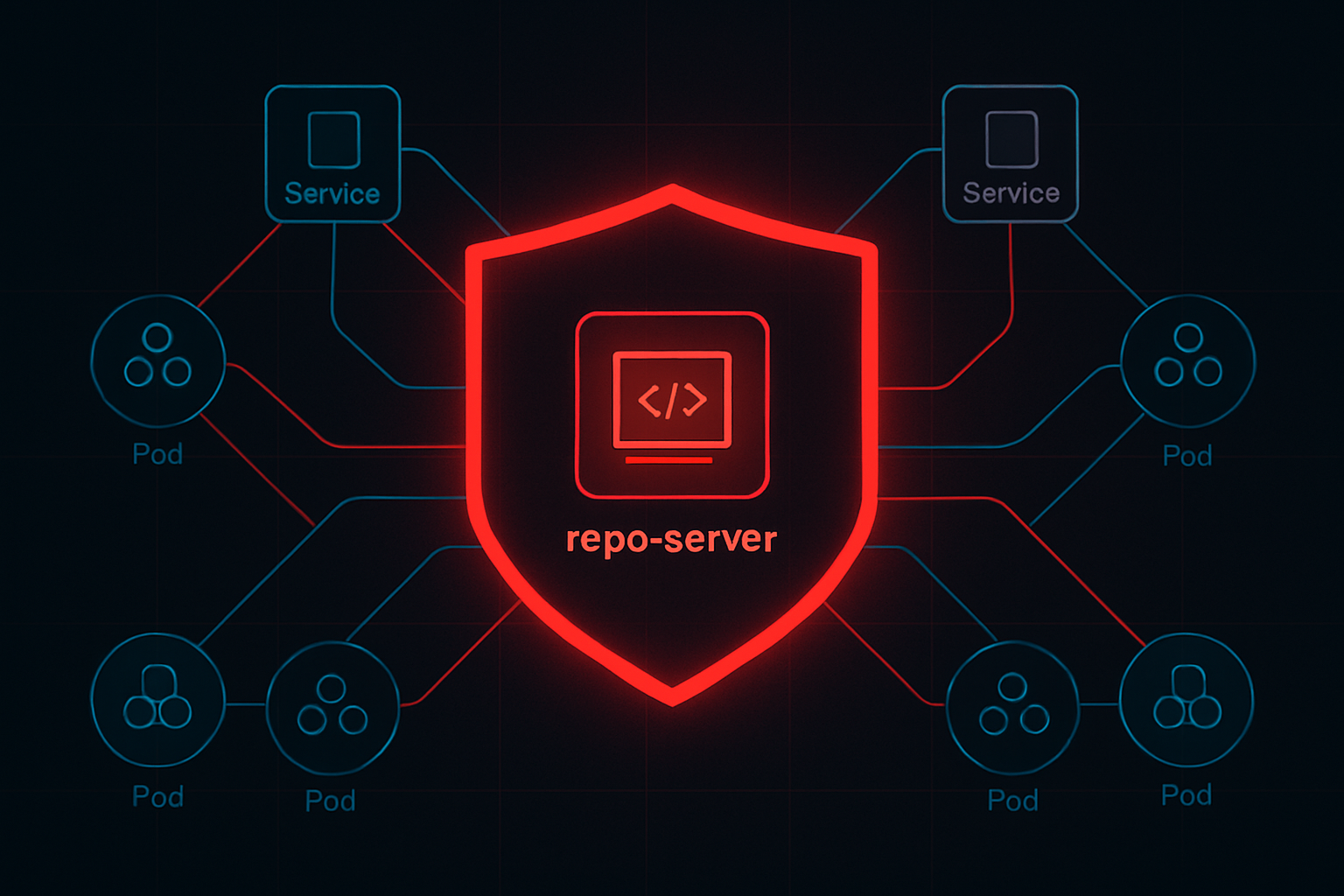
Kubernetes deployment automation tools like Argo CD simplify continuous delivery workflows, but they also introduce a significant attack surface if not properly isolated. Recent discovery of an unpatched remote code execution flaw in Argo CD's repo-server component illustrates how internal network exposure can turn a deployment tool into a cluster-wide compromise vector.
The Vulnerability: Internal Access, Maximum Damage
The flaw exists in Argo CD's repo-server component, which manages Git repository access and application manifests during deployment. An unauthenticated attacker who can reach the repo-server's internal network port gains the ability to execute arbitrary code with the privileges of the Argo CD service account. Within a Kubernetes cluster, a service account with default permissions often has broad cluster-level capabilities, making this a direct path to full cluster takeover.
The critical detail here is the network requirement: the attacker must have access to the internal port. This means the vulnerability is primarily exploitable from within the cluster network, or from external networks if the repo-server is incorrectly exposed. There is currently no published CVE and no patch available, leaving clusters running affected versions in a remediation limbo.
Why Internal Network Exposure Matters
Many infrastructure teams assume that internal Kubernetes services are safe simply because they're not directly accessible from the internet. This assumption has repeatedly proven dangerous. A compromised pod, a vulnerable sidecar, lateral movement from another service, or even an attacker with access to the cluster network (such as via a rogue container or supply-chain compromise) can abuse internal services at will.
Argo CD's repo-server is particularly sensitive because it handles authentication tokens, Git credentials, and manifests. It's also often deployed with cluster-admin or broadly permissive RBAC roles to simplify operations. Allowing unauthenticated access to its internal API means any lateral movement within the cluster can immediately escalate to cluster-wide compromise.
Practical Mitigation Until a Patch Arrives
Organisations running Argo CD should implement several layers of defence now:
- Network policies: Restrict traffic to the repo-server port to only the components that legitimately need it (the Argo CD API server, webhook handlers). Use Kubernetes NetworkPolicy or a service mesh to enforce this.
- Service mesh authentication: If using Istio or Linkerd, enforce mutual TLS and authorization policies at the mesh layer, even for internal traffic. This prevents unauthenticated access regardless of network topology.
- RBAC minimisation: Review the service account used by Argo CD and reduce its cluster-level permissions. Use namespace-scoped roles where possible, and bind permissions to specific resources and verbs.
- Pod security standards: Enforce strict pod security policies to reduce the likelihood of a compromised workload gaining lateral network access in the first place.
- Monitoring and audit logging: Enable audit logging on the Kubernetes API server and monitor for unexpected calls from the Argo CD service account or from unusual sources to the repo-server port.
Broader Lessons for Infrastructure Teams
The discovery of this unpatched flaw underscores a fundamental principle in infrastructure security: assume all internal services can be compromised, and design accordingly. Kubernetes clusters often host multiple tenants or applications, and the blast radius of a single unpatched vulnerability grows with each component that depends on or can reach that service.
The delay in patch availability also highlights the value of defence-in-depth. Even when a critical vulnerability exists without an immediate fix, thoughtful network segmentation, authentication enforcement, and RBAC design can prevent or significantly limit exploitation. Infrastructure operators managing hosted Kubernetes environments or Argo CD deployments should prioritise these controls immediately, regardless of patch status.
Until Argo CD maintainers release a patch, treat the repo-server as a high-value target in your cluster threat model and isolate it accordingly.